Neighbourhood Health and Care: Building the System Before the Structure
A systemic reading of the shift to neighbourhood working in England and Wales, and of the distinctive role available to Directors of Public Health within it — a framework-based assessment.
Theoretical basis: the laws and principles of systems theory, applied here as a diagnostic framework rather than as a source of opinion.
Executive Summary
This paper asks a bounded question: what do the laws and principles of systems theory reveal about the shift of health and social care toward “neighbourhood working” in England and Wales, and about what Directors of Public Health, leading public-health teams, can realistically do to help a coherent neighbourhood system come into being? It applies the framework directly to the situation on the ground, and adds a Vester-style sensitivity analysis of the indicative interventions the diagnosis points toward.
CENTRAL FINDING
Neighbourhood working is not an organisational-design problem; it is an attempt to bring a new level of system into existence between organisations that already exist and the population they jointly serve. That new level cannot be declared into being by boards, footprints or plans — it has to be grown through repeated, workable interdependence, and the national policy architecture in both countries is, to its credit, structured permissively enough to allow that. The distinctive contribution available to DPH-led public health is not to run the neighbourhood, but to supply the system intelligence, coordination discipline and outcome visibility that a self-organising process needs in order to become genuinely viable rather than merely co-located.
The six findings that follow are set out in full in the next section. In summary: neighbourhood working is system creation, not integration; the central design tension throughout is the Viability Principle’s balance of autonomy and cohesion, recurring self-similarly at every nested level; existing organisations are not a blank slate but a highly developed system whose stabilising feedback loops will pull neighbourhood behaviour back toward organisational behaviour unless directly altered; England’s Neighbourhood Health Framework is notable for what it does not say about public health’s own role; and a Vester cross-impact analysis of the indicative public-health capabilities identified below corroborates their sequencing by an independent method.
Findings
These findings are the headline output of the diagnosis. The technical analysis that follows names the specific systems principle behind each one and traces how it plays out in the current situation.
Finding 1. A system-creation problem, not an integration problem.
Neighbourhood working is best understood as an attempt to bring a new level of system into being between existing organisations and the population they jointly serve, not as an organisational-integration programme delivered through boards, plans and structures. That system exists only once there is enough repeated interaction and mutual adaptation for a recognisable pattern of behaviour to emerge (Self-Organising Principle).
Finding 2. Autonomy versus cohesion is the tension that recurs at every level.
The Viability Principle’s central tension — sub-system autonomy against whole-system cohesion, stability against adaptation — shows up self-similarly from an individual professional’s judgement, through the neighbourhood, up to place and ICB/RPB level (Fractal Principle), which is why no single-level fix is likely to resolve it on its own.
Finding 3. Existing feedback loops will win unless their structure, not just their inputs, is changed.
Organisational budgets, referral criteria and performance targets form strong, stabilising feedback loops (Feedback Dominance Theorem) that will pull neighbourhood behaviour back toward organisational behaviour unless a new structure alters those loops directly rather than simply sitting on top of them.
Finding 4. England’s framework is silent on public health’s own role.
The Neighbourhood Health Framework (17 March 2026) does not mention Directors of Public Health anywhere in its text; their system-leadership role rests on separate statutory ground — the Health and Social Care Act 2012 and 2026 guidance on healthcare public-health advice to ICBs — asserted from outside the framework’s own act of boundary-drawing (Law of Calling).
Finding 5. “More connections” is the wrong intuition; minimum sufficient architecture is the right one.
The Network Power Law and Complexity Instability Principle warn against connecting every partner directly to every other; the Root Structuration Theorem points instead toward deliberately clustering natural sub-systems and building a small number of reliable interfaces between them.
Finding 6. System intelligence and coordination architecture are the most systemically connected capabilities — and resource alignment is the one furthest from DPH control.
A Vester sensitivity analysis of the seven indicative public-health capabilities identified in this diagnosis, carried out independently of the core framework, corroborates the diagnosis by a different method — system intelligence and coordination architecture emerge as the most systemically connected and most fully within DPH-led public health’s own agency, while resource and agency alignment is as structurally central but depends on authority a DPH does not hold alone.
Technical Analysis
The remainder of this paper sets out the evidence and the systems-theory mechanism behind each finding above: the boundary of the system under examination, the situation on the ground, and the principle-by-principle diagnosis, its cross-cutting dynamics, and an independent sensitivity check on the interventions that follow from it.
1. System Framing and Method
1.1 System Framing
Systems laws describe the behaviour of a defined system in relation to its environment and are only meaningful once that boundary is set explicitly. The system of interest here is the neighbourhood itself, understood as nested within place/local-authority (England) or health-board (Wales) systems, which are in turn nested within the wider ICB/ICS or Regional Partnership Board architecture.
| System | The emerging neighbourhood health-and-care system in England and Wales — the coordinated, and in places co-governed, arrangement through which general practice, community services, social care, mental health, acute care, pharmacy, housing, VCSE organisations, public health and local communities jointly meet the needs of a defined population |
|---|---|
| Key components | General practice and primary-care networks/clusters; community health and adult and children’s social-care services; mental-health, acute and specialist providers; pharmacy; housing and VCSE organisations; local communities; Directors of Public Health and public-health teams, operating with system-leadership responsibilities but without direct operational control of most of the above |
| Environment | The wider nested systems each neighbourhood sits inside — place/local-authority and ICB structures in England, health-board and Regional Partnership Board structures in Wales — together with national policy (the Neighbourhood Health Framework and the Integrated Community Care System), workforce and funding markets, demography and inequalities, and the statutory and professional frameworks governing each constituent organisation |
| Key dynamic | A widening gap between the practical interdependence that already binds these organisations together — patients, information, money, risk and responsibility already cross between them whether or not this is acknowledged — and the weak shared institutional capability (a common model of the system, a deliberately designed coordination architecture, aligned resourcing, and governance that follows rather than precedes working relationships) needed to manage that interdependence as a system rather than as an aggregation of separately accountable parts |
1.2 Method
Each section below identifies the governing principle first, states the mechanism by which it operates, and only then derives the implication for neighbourhood working, so that findings remain traceable to a named principle rather than appearing as free-standing opinion. Principles are drawn from the full set of systems laws, thinking patterns and miscellaneous systems ideas, checked directly against the reference material rather than relied on from memory, and reported only where they materially apply — not as an exhaustive checklist. Interaction between principles (“splicing”) is noted at the point each connection is found, rather than deferred to a single later section.
2. Conventional Model and Systemic View Compared
Before turning to the situation itself, it is worth setting the two views side by side, since the contrast is the organising question of this paper.
| Conventional assumption | What the systemic view reveals |
|---|---|
| Neighbourhood working is an organisational-design and governance exercise — agree footprints, stand up integrated neighbourhood teams (INTs) and boards, and integration follows. | A neighbourhood is a new level of system, not a smaller geography with a board attached; it exists only once there is enough repeated interaction and mutual dependence for a recognisable pattern of behaviour to emerge (Self-Organising Principle). Governance built before that pattern exists will tend to reproduce the organisational allegiances its members already have (POSIWID). |
| Population size or administrative convenience is a sufficient basis for drawing a neighbourhood boundary. | The boundary chosen determines what can be seen and managed (Law of Calling); a workable neighbourhood boundary needs correspondence with real patterns of interdependence — primary-care populations, referral pathways, housing, deprivation — which will rarely coincide with administrative geography. |
| Integration means maximising connections — every relevant organisation should sit around the same table. | Structural complexity grows exponentially, not additively, with the number of connected elements (Network Power Law), and systems with too many active dependencies tend toward instability (Complexity Instability Principle); the design question is the minimum sufficient architecture of relationships, not the maximum. |
| Success is a single, agreed set of outcomes — better population health, better experience, lower demand, stronger community capacity — that a shared dashboard can track. | These are emergent properties of the neighbourhood system, not properties any one organisation produces (Principle of Emergence); optimising each organisation’s own metrics can improve local performance while displacing cost, demand or risk elsewhere in the system (Law of Reciprocity of Connections, Adams’ 3rd Law), leaving the whole no better off or worse. |
| Public health’s contribution is another service or strategy — a population needs assessment and a shared vision that other organisations then align behind. | Shared purpose is more plausibly an output of working interdependence than an input to it (Self-Organising Principle); public health’s more defensible early contribution is system intelligence — helping the emerging system build and continually test an adequate model of itself (Conant–Ashby Theorem) — with population strategy following once collective action is already demonstrably possible. |
3. Situation Brief
The picture across England and Wales in mid-2026 is one of national frameworks that are deliberately permissive on structure, leaving substantial scope for local interpretation of what neighbourhood working means for public health.
England: the Neighbourhood Health Framework. The Department of Health and Social Care published the Neighbourhood Health Framework on 17 March 2026, setting out an implementation path across two stages: foundational actions through 2026/27, and longer-term reform from April 2027 to March 2029, by which point local areas are expected to have agreed neighbourhood geographies and jointly owned outcome measures through Health and Wellbeing Boards. ICBs are asked to deliver a minimum set of interventions across three priorities — improving routine access, strengthening proactive care for people with complex needs, and providing alternatives to hospital-based care. The framework deliberately declines to prescribe a single national model for integrated neighbourhood teams (INTs) or fixed neighbourhood boundaries; footprints are expected to reflect “natural communities,” with a single neighbourhood provider typically serving a population of 30,000–50,000. Initial priority cohorts include frailty and end-of-life care, people with multiple long-term conditions, and — with a universal-access target of 2028/29 — children and young people.
A notable silence. The framework document itself contains no reference to Directors of Public Health or to public health as a function. Their system-leadership role rests instead on separate, general statutory footing: section 73A of the NHS Act 2006 (inserted by the Health and Social Care Act 2012) requires every local authority with public-health responsibilities to employ a specialist DPH, gives them a statutory place on the Health and Wellbeing Board, and establishes them as their authority’s principal adviser on health, with a cross-sector leadership brief spanning children’s and adult social care, NHS commissioning, resilience planning and community partnerships. Separately, current DHSC guidance on healthcare public-health advice to ICBs (published 13 January 2026, updated 24 July 2026) states that the DPH, as professional lead, should ensure the ICB has access to the public-health skills it needs across all four stages of strategic commissioning — understanding local context, population health strategy, resource allocation and evaluating impact — moving that advice beyond a transactional input into something closer to embedded strategic participation. Taken together, the statutory picture supports the claim that DPHs carry a legitimate system-leadership role; but that role is asserted onto neighbourhood working from outside the framework’s own boundary-drawing, not written into it, which is itself worth noting as a systemic observation (§4.2).
Wales: the Integrated Community Care System (ICCS). The Welsh Government’s ICCS position statement (19 December 2025) describes a whole-system approach uniting health and social-care programmes around preventative, person-centred, community-based care, reporting over £300 million in strategic investment in the preceding year, a Regional Integration Fund reaching some 750,000 people, and more than 100 capital schemes underway. Regional Partnership Boards (RPBs) — statutory bodies under the Social Services and Well-being (Wales) Act, bringing together health boards, local authorities and the third sector across seven regions — are described as “the driving force for collaboration and integration” rather than simply funding vehicles, with duties to produce regional population assessments, area plans and annual reports. Beneath RPBs, Pan Cluster Planning Groups (PCPGs) sit as sub-groups of health boards, bringing primary-care cluster leads together with local-authority and public-health representatives at county level to plan services that individual clusters cannot sensibly plan alone. Directors of Public Health in Wales sit as executive members of health-board boards — a materially different institutional position from their local-authority base in England, though the underlying systemic function (population intelligence, prevention, inequalities, service planning, partnership working) is recognisably the same in both countries.
What is unverified or unknown: whether the Neighbourhood Health Framework’s 2027/28 timetable for jointly owned outcome measures will hold; the extent to which Wales’s ICCS investment figures reflect new money versus redirected existing funding; how consistently the “no prescribed model” flexibility in both countries will be exercised in practice once implementation begins in earnest, rather than converging on a de facto standard model under delivery pressure; and, by the nature of a process this early in its life, what neighbourhood working will actually produce as opposed to what it is designed to produce — which is precisely the distinction §4.13 below addresses directly.
4. Systemic Diagnosis
The table below sets out the principles that materially apply to this situation, the mechanism by which each operates, and the effect it implies for neighbourhood working. Discussion of each, and the connections between them, follows.
| Principle & Core Statement | Predicted / Observed Systemic Effect | Neighbourhood System Impact |
|---|---|---|
| Self-Organising Principle + System Resonance Principle Parts generate wholes; resonance between systems strengthens the coupling between them. | A neighbourhood exists as a system only once there is enough repeated interaction and mutual adaptation for a recognisable pattern to emerge; that process typically runs from independent agencies, through coordination and alignment, to shared governance — not the reverse. | Declaring a neighbourhood into existence by naming a footprint and a board does not create the system; it creates a label that the underlying organisational system will, absent other forces, continue to resonate with more strongly than with the neighbourhood. |
| Law of Calling + Law of Crossing Difference creates boundaries and boundaries create difference; crossing a boundary is a change of state. | Choosing where the neighbourhood boundary sits determines what can be seen and managed; the Neighbourhood Health Framework’s silence on public health is itself a boundary choice, made from outside by statutory guidance rather than inside the framework’s own text. | Whether DPH-led public health is treated as inside or outside the neighbourhood system will shape what the neighbourhood can see about itself; the same law explains why every organisational hand-off a person experiences (§4.9) is a change of state, not a neutral administrative step. |
| Law of Requisite Variety Control of a system requires variety at least equal to the variety it faces; only variety can destroy variety. | Highly local variety — social isolation, housing conditions, community trust, particular vulnerable populations — is best matched by neighbourhood-level autonomy; other variety (rare specialist need, workforce markets, major capital, technical infrastructure) is better matched at higher levels. | The design question is not “what should be devolved?” but “for each kind of variety, which level can actually absorb it?” — a reciprocal test, since what must stay at higher levels determines what can sensibly be devolved, and vice versa. |
| Viability Principle + Power Structuration Theorem Viability depends on balancing sub-system autonomy against whole-system cohesion, and stability against adaptation; a nested system has optimal agency when the system’s need for agency is balanced against that of its sub-systems. | Too little neighbourhood autonomy produces co-location without integration — staff sit together but remain governed by different budgets and chains of command; too much produces fragmentation and an inability to marshal resources only larger systems can provide. | The answer is differentiated autonomy, function by function — “must be common / may vary / should vary” — rather than a general commitment to either centralisation or devolution; resource authority has to track that same allocation, or responsibility is devolved without the agency to discharge it (§4.10). |
| Homeostasis Principle A system is stable so long as its key variables remain within their physiological limits. | Neighbourhood working touches several variables that plausibly need to be held within limits together — waiting times, workforce capacity, referral thresholds, budget balance across partners — but there is no single accepted mechanism regulating them jointly; each partner instead runs its own homeostat over its own variables. | Without an explicit, jointly tracked set of neighbourhood-level critical variables, protecting one partner’s variable (a hospital’s length of stay, a practice’s list size) can push another partner’s variable outside its own tolerable range, with no shared mechanism to notice or correct it. |
| Feedback Dominance Theorem Loops with strong feedback take a system where they take it, largely irrespective of the size of the input. | Existing organisational budgets, contracts, professional identities, referral criteria and performance targets form powerful negative-feedback loops that continually reproduce organisational rather than neighbourhood behaviour. | Placing a new neighbourhood structure on top of these loops without altering their structure or gain will generally result in the loops winning; the diagnostic question is not “what new structure do we need?” but “which existing mechanisms continually recreate fragmentation, and can their structure be changed?” |
| Complexity Instability Principle + Network Power Law Structural complexity grows exponentially with the number of connected elements; systems with too many active dependencies tend toward instability. | Neighbourhood working potentially connects general practice, community and social care, mental health, acute care, pharmacy, housing, VCSE organisations, communities and public health; connecting all of them directly to all of the others is not more integration, it is a route to instability. | The practical test is whether an integration mechanism removes more dependencies than it creates — a shared triage protocol that eliminates several bilateral referral relationships achieves more integration, at lower continuing cost, than a weekly MDT that requires twelve organisations to attend. |
| Root Structuration Theorem Complexity is minimised when a system is structured so its number of sub-systems approaches the square root of its number of elements. | The reference material’s own antidote to the Complexity Instability Principle is to cluster elements into sub-systems with stronger dependencies within each cluster than between clusters, rather than either a single flat network or a single central controller. | This gives a formal basis for a coordination architecture that identifies natural clusters of dependency — for instance, professionals who repeatedly need to coordinate around frailty — and builds reliable interfaces between clusters rather than universal participation across all of them. |
| Principle of Emergence The whole is more than the sum of its parts; a system’s emergent properties are not producible by any one part alone. | Population health and inequalities, experience and continuity, demand and cost, and community capacity are emergent properties of the neighbourhood system, arising from interaction between services, populations and environments — not outputs any single organisation can generate alone. | Treating these as four sets of organisational KPIs risks the POSIWID error below — assuming the system’s purpose is what its designers intended rather than actively looking for what it is actually producing. |
| Law of Reciprocity of Connections + Adams’ 3rd Law If A connects to B, B also connects to A even where institutional accounting recognises only one direction; a system composed entirely of the lowest-risk components available will itself be a high-risk system. | Each partner minimising its own organisational risk — a hospital tightening length of stay, a practice narrowing eligibility, a local authority protecting its budget — is individually rational; connections that appear to run one way in fact run both ways, since the receiving service absorbs the consequence whether or not the accounting recognises it. | The aggregate of many individually low-risk organisational choices is a high-risk whole precisely because no actor is accountable for the system-level consequence; a shared outcomes framework needs to look explicitly for displacement, not just for shared outcomes improving in parallel. |
| Conant–Ashby Theorem + Darkness Principle Every good regulator of a system must be a model of that system; there is always something about a system you cannot know. | Public health’s most distinctive early contribution is model-building — a live, testable model of the neighbourhood’s population, services, flows, dependencies, feedback loops and outcomes. But no such model, however good, will ever be complete. | The Darkness Principle does not excuse the modelling effort — it sharpens it: the posture should be a neighbourhood capable of learning that its model is wrong, not one that believes it has found the correct model of itself once and for all. |
| Two Black Box Principles It is not necessary to enter a black box to understand the nature of the function it performs, or the variety it can generate — tracking its outputs reliably can substitute for full internal knowledge. | The Conant–Ashby requirement for an adequate model does not mean public health needs to model the clinical or operational internals of every partner organisation. | For most partners, reliably tracking outputs — what goes in, what comes out, how consistently — is sufficient; this bounds the system-intelligence task to something a neighbourhood-scale team can plausibly sustain, rather than an impossible full-system model. |
| Redundancy of Potential Command Principle Effective action in a complex situation depends on bringing together an adequate concatenation of information. | Organisations, in Hoverstadt’s corollary, tend to take the decisions their available information enables them to take. Where information about cross-boundary consequences is missing, decisions will systematically fail to account for them. | This is a second, sharper argument (beyond Requisite Variety) for building shared information architecture early — not only does better information improve any one decision, the absence of it predictably produces the organisationally rational, system-blind decisions the diagnosis identifies throughout. |
| Relaxation Time Principle + System Survival Theorem A system shocked repeatedly at intervals shorter than its recovery time may never stabilise; a system fails if its environment changes faster than the system itself does. | Continual restructures, new initiatives, dashboards and partnership requirements are themselves a rate of environmental change imposed on the neighbourhood from above; if that rate outpaces the neighbourhood’s own relaxation time, repeated relationships never get the chance to stabilise into anything resembling a system. | Change saturation is not simply a delivery-management irritant; it is the System Survival Theorem operating directly on the neighbourhood as a system — the sponsoring programme’s own pace of change can be the thing that prevents the neighbourhood surviving as a coherent system at all. |
| Structural Viability Theorem A system has optimal viability when its rate of change relative to its environment matches that of its sub-systems. | Different clinical and service domains within the same neighbourhood face different rates of external change and different levels of pre-existing interdependence — frailty pathways are typically far more developed than integration around children’s services. | A neighbourhood with mature integrated working around frailty, basic coordination around mental health, and almost no integration around children’s services is not evidence of failure; forcing every domain to the same organisational form on the same timetable would itself violate both this theorem and Requisite Variety. |
| Fractal Principle Systems tend to replicate their own structural form across different levels of scale. | The same pattern recurs at every level examined: an individual professional balancing local judgement against organisational protocol; a neighbourhood balancing local responsiveness against upward accountability; a place or ICB/RPB balancing devolution to neighbourhoods against its own statutory duties. Even the citizen’s experience of crossing between services echoes the same boundary logic at the most local level of all. | Because the autonomy/cohesion mismatch is fractal, an intervention aimed at only one level is unlikely to resolve a tension reproduced at every other level; the nested-system design task in §4.4 has to be worked through explicitly at each level, not solved once and assumed to hold throughout. |
| POSIWID (miscellany) The purpose of a system is what it does, not what its designers intend. | What neighbourhood working actually produces — more meetings, new interfaces, duplicated accountability, additional professional workload — may differ substantially from its stated purpose, however attractive that purpose is. | The system-intelligence function has to include actively observing behaviour, not architecture — fewer or more hand-offs, shifted demand, improved or worsened continuity, changed resource flows are the evidence, and unintended outcomes have to be treated as data about the real system rather than explained away. |
4.1 A neighbourhood cannot be declared into existence
The Self-Organising Principle holds that parts generate wholes — that a higher-level structure emerges from the interaction of its constituent parts rather than being imposed on them from outside. A plausible sequence for neighbourhood formation — independent agencies encountering interdependence, coordination developing, alignment following, and only then a shared model of need and governance — follows directly from this, and from what the reference material identifies as the System Resonance Principle underpinning it: repeated, workable fit between organisations is what allows the bond between them to deepen, exactly as the process of structural coupling under the Conservation of Adaptation Principle describes. A geographical footprint, named from outside by a national framework, is a candidate boundary (Law of Calling, §4.2) for a system that does not yet exist; it becomes a system only once enough of that interaction has actually occurred. This is also why placing governance last, rather than first, is systemically defensible rather than merely counter-intuitive: a governance structure imposed on a set of organisations that have not yet developed working patterns of coordination has, in Beer’s sense, no real system to govern, and will tend to reproduce the organisational allegiances of its members — the specific mechanism POSIWID (§4.13) names directly.
4.2 A boundary the framework itself leaves silent
The Law of Calling holds that the act of drawing a system boundary is a judgement, not the discovery of a natural line — “the difference that makes a difference,” in Bateson’s phrase quoted in the reference material — and its partner, the Law of Crossing, adds that moving across a boundary is itself a change of state, for both what crosses and the observer. England’s Neighbourhood Health Framework applies a version of this reasoning to geography, deliberately declining to fix neighbourhood footprints nationally so that local areas can draw boundaries around genuine “natural communities.” But the same framework draws a second, less examined boundary: it says nothing at all about Directors of Public Health or public health as a function. That is a genuine finding of this review’s research, and it matters systemically rather than merely administratively. DPH system leadership rests on separate statutory ground — the Health and Social Care Act 2012 and current guidance on healthcare public-health advice to ICBs — asserted onto neighbourhood working from outside the framework’s own act of Calling, not written into the system as the framework itself defines it. That is not necessarily a weakness: the observation that the DPH does not need to control the neighbourhood system to be useful to it — occupying, instead, “a meta-system role” — is arguably strengthened by sitting formally outside the boundary the framework draws, since that position carries less of the accountability-defending behaviour (§4.10) that afflicts partners named inside it. But it is a choice worth naming rather than assuming, and it means public health’s legitimacy in this space currently rests on statute and guidance rather than on the framework’s own design.
4.3 The real design question is which level absorbs which variety
The Law of Requisite Variety states that control of a system requires variety at least equal to the variety the system presents; only variety can destroy variety. Applied here, the practical question is not “what should be devolved to neighbourhoods?” but, for each distinct kind of variety a population presents, which level of the nested system — neighbourhood, place, ICB/RPB, or national — actually has the capacity to absorb it. Highly local variety (social isolation, housing conditions, particular vulnerable populations, the texture of trust between a practice and a voluntary organisation) plausibly needs neighbourhood autonomy to be handled well; other variety (rare specialist need, workforce markets, major capital, technical infrastructure, some data architecture) is better absorbed at scale. The two conditions are reciprocal: what must remain at higher levels constrains what can sensibly be devolved, and what neighbourhoods genuinely need to manage locally is itself a claim on what higher levels must supply. That reciprocity is the practical content behind the Viability Principle discussed next.
4.4 Differentiated autonomy, not a preference for either pole
The Viability Principle — arguably the single most load-bearing law in this diagnosis — holds that a system’s viability depends on continuously balancing the autonomy of its sub-systems against the cohesion of the whole, and stability against adaptation, rather than settling permanently on one side of either tension. The Power Structuration Theorem sharpens the autonomy dimension specifically: a nested system has optimal agency when the system’s own need for agency is balanced against the need for agency of its constituent sub-systems. Applied to neighbourhood working, too little autonomy produces co-location without integration — staff around the same table, still governed by different budgets, thresholds and reporting lines; too much produces fragmentation, duplication and an inability to marshal resources that only a larger system can provide. Neither extreme is correct in general, which is precisely the Viability Principle’s point: the useful move is a repeated, function-by-function test — “must be common / may vary / should vary” — rather than a general ideological commitment to devolution or to central standardisation. Because responsibility without resource authority is nominal rather than real agency, this classification has to extend into resource and decision rights (§4.10), not stop at functional allocation.
4.5 Homeostasis without a shared homeostat
The Homeostasis Principle states that a system remains stable only so long as its key variables are held within their physiological limits — this is the framework’s own name for the way population health, experience, demand/cost and community capacity function here as variables that can trade off against one another. Neighbourhood working plausibly touches several such variables that matter jointly — waiting times, workforce capacity, referral thresholds, each partner’s budget position — but, as things stand, no single mechanism regulates them together; each organisation instead runs its own homeostat over its own variables, exactly as it always has. That produces a specific, predictable failure mode: protecting one partner’s variable can push another’s outside its own tolerable range, with no shared mechanism positioned to notice, let alone correct it. This is the systems-theoretic version of an “organisational optimisation” failure mode (§4.10), and the natural response — a jointly tracked, explicit set of neighbourhood-level critical variables — is one of the capabilities carried forward into Appendix B.
4.6 Feedback that already knows where it’s going
The existing health-and-care system is not a blank slate waiting for a neighbourhood structure to be laid over it; it is itself a highly developed system with powerful stabilising feedback loops — organisational budgets, contracts, professional identities, referral criteria, performance targets, workforce arrangements — that continually reproduce organisational behaviour. The Feedback Dominance Theorem states that loops with strong feedback take a system where they take it, largely irrespective of the size of the initial disturbance; a modest new neighbourhood team introduced on top of these loops, without altering their structure or gain, will generally see the loops win. This reframes the central diagnostic question usefully: not “what new neighbourhood structures do we need?” but “which existing mechanisms continually recreate fragmentation, and can their structure — not merely their inputs — be changed?” It also connects forward to Relaxation Time and System Survival below: a neighbourhood cannot out-adapt loops this strong if it is simultaneously being destabilised by the pace of the programme meant to build it.
4.7 Structural complexity is not solved by more connections
The Network Power Law states that structural complexity grows exponentially, not additively, with the number of connected elements — using the underlying formula (2ⁿ − (n+1)): a system of sixteen loosely connected nodes has over 65,000 possible communication permutations. The Complexity Instability Principle follows directly: systems with too many active, changing dependencies between their parts tend to become incipiently unstable, with each perturbation triggering further perturbations in a chain that may never settle. Neighbourhood working potentially brings together general practice, community services, social care, mental health, acute care, pharmacy, housing, VCSE organisations, communities and public health; connecting all of them directly to all of the others is not more integration, it is a structural risk. What the reference material adds here is the Root Structuration Theorem: complexity is minimised, not by a single central controller or by universal connection, but by structuring a system so its number of sub-systems approaches the square root of its number of elements — clustering elements so that dependencies are stronger within each cluster than between clusters. This gives formal backing to a coordination architecture that identifies natural clusters of dependency (professionals who repeatedly need to coordinate around frailty, say) and build a small number of reliable interfaces between clusters, rather than requiring universal participation in every forum. The practical test this yields — does this integration mechanism remove more dependencies than it creates? — is one of the sharper, more exportable findings in this diagnosis.
4.8 Outcomes are emergent, and emergence can be exported elsewhere
The Principle of Emergence holds that a system’s whole is more than the sum of its parts — a property like population health or continuity of care belongs to the interaction between services, populations and environment, not to any one organisation. Treating population health and inequalities, experience and continuity, demand and cost, and community capacity as four sets of organisational KPIs risks losing exactly this: if every organisation optimises its own metric, the neighbourhood need not improve, and some organisational performance can improve precisely by exporting difficulty elsewhere — tighter eligibility reducing one waiting list while increasing urgent-care demand or unpaid caring, for instance. The Law of Reciprocity of Connections explains why this is not really an externality at all: if A connects to B, B also connects to A, even where institutional accounting recognises only one direction, so a cost that appears to leave one organisation’s books has in fact simply moved, not disappeared. Adams’ 3rd Law supplies a sharper, more counter-intuitive version of the same point: a system built entirely from components each individually selected to minimise its own risk will itself be a high-risk system, because the compromises needed for genuine system-level integration are, by construction, nobody’s specific job. Each partner protecting its own budget, its own thresholds, its own statutory duties is individually prudent; the aggregate is a neighbourhood system that is fragile precisely because no actor is accountable for its coherence. The practical implication for the outcomes framework in Appendix B is direct: it needs to look explicitly for displacement — cost, workload, waiting, responsibility and unmet need migrating across organisational boundaries — not merely for four indicators moving in the right direction.
4.9 A model that does not need to be complete
The Conant–Ashby Theorem — effective regulation of a system requires an adequate model of that system — is the clearest statement of why public health’s most distinctive early contribution is model-building rather than service delivery: a live, testable model of the neighbourhood’s population, services, flows, dependencies, feedback loops and outcomes. The Darkness Principle qualifies this usefully rather than undermining it: no system, including a well-modelled neighbourhood, can ever be known completely, so the posture required is not “we have found the correct model” but “we have built a neighbourhood capable of learning that its model is wrong” — precisely the continuous model-intervene-observe-revise loop that the discussion of the meta-failure mode below converges on (§4.13). A further, practically important qualification, not previously drawn out, comes from the Two Black Box Principles: it is not necessary to enter a black box to understand the function it performs or the variety it can generate — tracking its outputs reliably can substitute for full internal knowledge. Public health does not need to model the clinical or operational internals of every partner organisation to hold an adequate model of the neighbourhood; for most partners, reliable output tracking is sufficient. This bounds the modelling task to something a neighbourhood-scale team can plausibly sustain, and it connects directly to the Redundancy of Potential Command Principle: effective action depends on bringing together an adequate concatenation of information, and — in Hoverstadt’s corollary — organisations tend to take the decisions their available information enables them to take. Where cross-boundary information is missing, organisationally rational, system-blind decisions are not a moral failing; they are the predictable output of an information gap.
4.10 Resources, agency, and the limits of what a DPH can move
Alignment eventually reaches money and authority, and this is where the Viability and Power Structuration principles discussed in §4.4 meet their hardest test. A neighbourhood with responsibility but not resource authority has nominal, not actual, agency; wholesale pooling imposed before relationships can support it risks resistance and instability. A staged approach to resource integration — transparency, then joint decision-making, then limited discretionary resources, then deeper pooling where relationships can carry it — follows directly from the Viability Principle’s own logic of balancing tensions rather than resolving them once. What is worth naming explicitly is a limit implicit in this logic: this is the one capability, among those carried into Appendix B, that DPH-led public health cannot substantially deliver alone. Public health can diagnose the mismatch between responsibility, information, authority and resources, and can convene the conversation about it; it cannot itself transfer the money, statutory authority or workforce control required to correct that mismatch. The Power Structuration Theorem explains why the mismatch matters; it does not confer on a DPH the agency to resolve it. This is not a reason to omit resource and agency alignment from the analysis — its systemic centrality means the opposite — but it is a reason to keep it visibly distinct from the capabilities DPH-led teams can more directly own, which the Vester analysis in Appendix B addresses on its own terms.
4.11 Change saturation is an environmental-rate problem, not just a delivery one
The Relaxation Time Principle warns that a system shocked repeatedly at intervals shorter than its recovery time may never stabilise. This applies directly to continual restructures, new initiatives, dashboards and partnership requirements arriving faster than neighbourhood relationships can settle. What sharpens this further, and was not named explicitly, is the System Survival Theorem: a system fails if its environment changes faster than the system itself can adapt. The sponsoring programme’s own pace of change is, from the neighbourhood’s point of view, part of its environment — and if that rate consistently outpaces the neighbourhood’s relaxation time, the programme intended to build the system can itself be the mechanism preventing the system from ever stabilising enough to be recognised as one. The practical implication follows directly: countermeasures need to protect the emerging neighbourhood system from the pace of the programme intended to create it — the System Survival Theorem gives that intuition a named mechanism rather than leaving it as an aphorism.
4.12 Uneven maturity across domains is not evidence of failure
A further principle worth naming explicitly is the Structural Viability Theorem — a system has optimal viability when its rate of change relative to its environment is similar to that of its sub-systems — but different sub-systems, coupled to different parts of a changing environment, will rarely need to change at the same rate. In practice, a neighbourhood might show mature integrated working around frailty, basic coordination around mental health, and almost no integration around children’s services — not necessarily evidence of failure. The Structural Viability Theorem supplies the formal basis for that judgement — forcing every domain onto the same organisational form on the same timetable would violate both this theorem and the Law of Requisite Variety, since different domains face different external rates of change and different starting levels of pre-existing interdependence. Evaluation frameworks for neighbourhood working should be built to expect and interpret this unevenness, rather than treating domain-by-domain inconsistency as a programme-management defect to be eliminated.
4.13 The same pattern, and the meta-failure that sits above it
The Fractal Principle — systems tend to replicate their own structural form across different levels of scale — is visible throughout this diagnosis without previously being named. An individual professional balances local clinical judgement against organisational protocol; a neighbourhood balances local responsiveness against upward accountability to place or ICB/RPB; a place or region balances devolution to neighbourhoods against its own statutory duties upward again. Even the citizen’s experience of crossing between services — new eligibility criteria, another assessment, another professional language, each a change of state under the Law of Crossing discussed in §4.2 — echoes the identical boundary logic at the most local level of all, distributed most heavily onto people least able to absorb it (a direct application of Requisite Variety to inequalities). Because the mismatch is fractal, no single-level intervention is likely to resolve a tension reproduced at every other level; nested-system design (§4.4) has to be worked through explicitly level by level, not solved once centrally and assumed to hold throughout. Above all of this sits a meta-failure: mistaking the intended system for the actual one. POSIWID — the purpose of a system is what it does, not what its designers intend — means that if neighbourhood working repeatedly produces additional meetings, new interfaces, duplicated accountability and increased professional workload, that, however unattractive, is the system currently being created, whatever its stated purpose. The corrective is not a better statement of intent but active, repeated observation of behaviour rather than architecture: fewer or more hand-offs, shifted demand, better or worse continuity, changed resource flows, treated as evidence about the real system rather than explained away as implementation friction around an otherwise sound design.
5. Cross-Cutting Dynamics
Read together, the principles above converge on a single structural account rather than a list of independent findings. Neighbourhood working is an attempt at self-organisation (§4.1) into a system whose boundary is only partly drawn by the framework meant to create it — most strikingly, the framework is silent on the very profession this review was commissioned to advise (§4.2). That silence matters because the central tension running through every other finding is the Viability Principle’s balance of autonomy against cohesion (§4.4), a tension that recurs self-similarly at every nested level examined, from an individual professional’s judgement to the citizen’s experience of crossing between services to the place-and-region architecture above the neighbourhood (§4.13, Fractal Principle) — which is exactly why no single-level fix, however well designed, is likely to resolve it. Requisite Variety (§4.3) gives that tension its practical test — which level can absorb which kind of variety — and Homeostasis (§4.5) gives it a missing mechanism: without a jointly tracked set of critical variables, protecting one partner’s variable can silently breach another’s, and the Law of Reciprocity of Connections together with Adams’ 3rd Law (§4.8) explains why this is not an externality but a structural feature of a system built from individually risk-minimising parts. None of this is happening on a blank slate: existing feedback loops are strong enough, by the Feedback Dominance Theorem (§4.6), to pull any new neighbourhood structure back toward organisational behaviour unless their structure is altered directly, and the Complexity Instability Principle and Network Power Law (§4.7) warn against the intuitive response of simply connecting everyone to everyone in an effort to overcome that pull — the Root Structuration Theorem points instead toward deliberately clustered, minimum-sufficient architecture. Public health’s distinctive available contribution, system intelligence under Conant–Ashby and bounded by the Darkness Principle and the Two Black Box Principles (§4.9), is what allows the rest of this to be tested against reality rather than assumed — but it runs into a hard limit at resource and agency alignment (§4.10), which depends on authority a DPH does not hold alone. Holding all of this together requires protecting the neighbourhood’s own relaxation time against a change-saturated policy environment (§4.11) and expecting, rather than penalising, uneven maturity across clinical domains (§4.12). The single risk that sits above all of these is POSIWID (§4.13): that neighbourhood working comes to be judged by its stated purpose rather than by what it is actually observed to produce, which is precisely the discipline the sensitivity analysis below is designed to test independently.
Conclusion
Applied consistently, the laws and principles of systems theory support a central reframing: the shift to neighbourhood working is better understood as an attempt to bring a new level of system into being between existing organisations and the population they jointly serve, not as an organisational-integration programme that structures, boards and plans can deliver directly. That new level cannot be declared into existence; it has to be grown through repeated, workable interdependence, tested against strong existing feedback loops that will otherwise pull it back toward organisational behaviour, and protected from a pace of externally imposed change that could prevent it stabilising at all. The central tension throughout — autonomy against cohesion, stability against adaptation — recurs self-similarly at every level examined, from an individual professional’s judgement to the citizen’s experience of crossing between services to the architecture connecting neighbourhoods to places, ICBs and Regional Partnership Boards above them, which is why no single-level intervention is likely to resolve it on its own. Public health’s distinctive, defensible contribution is system intelligence and coordination discipline — capabilities the Vester analysis in Appendix B, carried out independently of the core framework, confirms as the most systemically connected in the portfolio and the most fully within DPH-led public health’s own agency. Resource and agency alignment sits just as centrally in the same analysis, but depends on authority a DPH does not hold alone; naming that limit clearly, rather than presenting every systemic finding as a DPH action, is itself one of this diagnosis’s findings. Neither England’s Neighbourhood Health Framework nor Wales’s Integrated Community Care System settles these tensions by design — both, appropriately, leave room for local variation rather than prescribing a single model — which means the practical test of everything in this paper will be what neighbourhood working is observed to actually produce, not what any framework, this one included, intended it to.
Appendix A — Glossary of Systems Principles Referenced
| Principle | Definition |
|---|---|
| Self-Organising Principle | Parts generate wholes; higher-level structure emerges from the interaction of a system’s constituent parts rather than being imposed on them from outside. |
| System Resonance Principle | Resonance between systems, based on similarity or productive difference, strengthens the coupling and communication between them. |
| Law of Calling | The act of making a distinction is the act of drawing a boundary and defining a system; difference creates boundaries and boundaries create difference. |
| Law of Crossing | Crossing a system boundary is itself a change of state, for both what crosses and the observer. |
| Law of Requisite Variety | The control achievable over a system is limited by the variety of the regulator relative to the variety of the system being regulated; only variety can destroy variety. |
| Viability Principle | A system’s viability depends on balancing the autonomy of its sub-systems against the cohesion of the whole, and stability against adaptation, over time. |
| Power Structuration Theorem | A nested system has optimal agency when the need for agency at the system level is balanced against the need for agency of its constituent sub-systems. |
| Homeostasis Principle | A system survives only so long as its essential variables are maintained within their physiological limits. |
| Feedback Dominance Theorem | Loops with strong feedback will take a system where they take it, largely irrespective of the size of the input. |
| Complexity Instability Principle | Systems with too many active, changing dependencies between their parts tend to become incipiently unstable. |
| Network Power Law | Structural complexity grows exponentially (broadly as the square) of the number of interconnected elements in a system. |
| Root Structuration Theorem | Complexity is minimised when a system is structured so the number of its sub-systems approaches the square root of the number of its elements. |
| Principle of Emergence | The whole is more than the sum of its parts; emergence is a property of a system that is not a property of any of its parts on their own. |
| Law of Reciprocity of Connections | If A connects to B, then B also connects to A, even where institutional accounting recognises only one direction. |
| Adams’ 3rd Law | A system composed entirely of the lowest-risk components available will itself be a high-risk system. |
| Conant–Ashby Theorem | Every good regulator of a system must be a model of that system; the ability to act effectively on any situation depends on the adequacy of your model of it. |
| Darkness Principle | No system can be known completely by any observer or sub-system; irreducible unknowns are structural, not incidental. |
| Two Black Box Principles | It is not necessary to enter a black box to understand the nature of the function it performs, or the variety it may generate — tracking outputs reliably can substitute for full internal knowledge. |
| Redundancy of Potential Command Principle | Effective action in a complex decision network depends on bringing together an adequate concatenation of information. |
| Relaxation Time Principle | A system can only remain stable if its relaxation time is shorter than the average interval between disturbances. |
| System Survival Theorem | A system survives only if it can change at a rate greater than or equal to the rate of change in its environment. |
| Structural Viability Theorem | A system has optimal viability when its rate of change relative to its environment is similar to that of its sub-systems. |
| Fractal Principle | Systems tend to replicate their own structural form across different levels of scale. |
| POSIWID (miscellany) | “The Purpose Of a System Is What It Does” — a system’s real, emergent purpose is revealed by its actual behaviour rather than by the intentions ascribed to it. |
Appendix B — Vester Sensitivity Analysis of Indicative Interventions
Additional lens (outside the core framework): this appendix reports a Vester-style cross-impact and sensitivity analysis of the indicative public-health capabilities identified in this diagnosis, carried out for this review at the user’s request. The method is not part of the systems-principles framework used in the body of this paper; it is presented here, clearly separated as an appendix, because it independently tests the sequencing logic the diagnosis above already implies, without displacing that diagnosis as the primary analysis.
B.1 The intervention set
The diagnosis above resolves into six connected public-health capabilities, plus a seventh that is kept deliberately distinct because DPH-led public health cannot deliver it alone (§4.10). Those seven form the intervention set scored below.
C1 — System intelligence and learning. A live, continuously tested model of population, services, flows, boundaries, dependencies, feedback loops and outcomes (§4.9), bounded by treating most partner organisations as black boxes tracked on output rather than modelled in full internal detail.
C2 — Coordination architecture. Mapping informational, physical, stakeholder and structural dependencies; distinguishing routine, high-volume coordination from genuinely complex, low-volume coordination; clustering natural sub-systems and building interfaces between clusters rather than universal participation; actively testing whether a new mechanism removes more dependencies than it creates (§4.7).
C3 — Nested-system design. An explicit “must be common / may vary / should vary” classification, tested function by function against decision rights, resources and information, and repeated at each nested level rather than solved once centrally (§4.4, §4.13).
C4 — Outcomes, inequalities and displacement. Monitoring the four emergent outcome domains while explicitly searching for displacement — cost, workload, waiting, responsibility and unmet need migrating across organisational boundaries rather than disappearing (§4.8).
C5 — Developmental conditions. Protecting time for relationships to stabilise; tracking cumulative change burden as an explicit “change budget”; sequencing initiatives; allowing coordination structures to emerge before formalising them into governance (§4.1, §4.11).
C6 — Citizen-facing complexity reduction. Treating people’s journeys as a sequence of boundary crossings; identifying and redesigning avoidable crossings, repeated assessments and wrong doors, concentrated on populations least able to absorb navigation burden (§4.2, §4.13).
C7 — Resource and agency alignment. Matching responsibility, information, authority and resources function by function; staged transparency, joint decision-making and, where relationships can support it, deeper pooling — the one capability that depends on partners’ money and statutory authority rather than on anything DPH-led public health can supply alone (§4.10).
B.2 Cross-impact matrix
Each row was scored 0 to 3 for how strongly implementing that capability would strengthen the feasibility or effectiveness of each column capability — an influence matrix, not a cost or effort estimate. Total active and total passive influence both sum to 70.
| From ↓ / To → | C1 | C2 | C3 | C4 | C5 | C6 | C7 | Active sum |
|---|---|---|---|---|---|---|---|---|
| C1 | — | 3 | 3 | 3 | 2 | 2 | 2 | 15 |
| C2 | 2 | — | 2 | 1 | 2 | 3 | 1 | 11 |
| C3 | 1 | 2 | — | 2 | 1 | 1 | 3 | 10 |
| C4 | 2 | 1 | 1 | — | 1 | 2 | 2 | 9 |
| C5 | 1 | 2 | 1 | 1 | — | 2 | 1 | 8 |
| C6 | 1 | 1 | 1 | 2 | 1 | — | 1 | 7 |
| C7 | 1 | 2 | 2 | 1 | 2 | 2 | — | 10 |
| Passive sum | 8 | 11 | 10 | 10 | 9 | 12 | 10 | 70 |
B.3 Sensitivity quadrant model
Each capability’s active score (its row total — how strongly it influences the rest of the portfolio) is plotted against its passive score (its column total — how strongly it is influenced by the rest). The product indicates total system connectivity; the quotient indicates whether a capability is predominantly driving or driven. The mean active and passive score across the portfolio is 10, used here as the quadrant division.
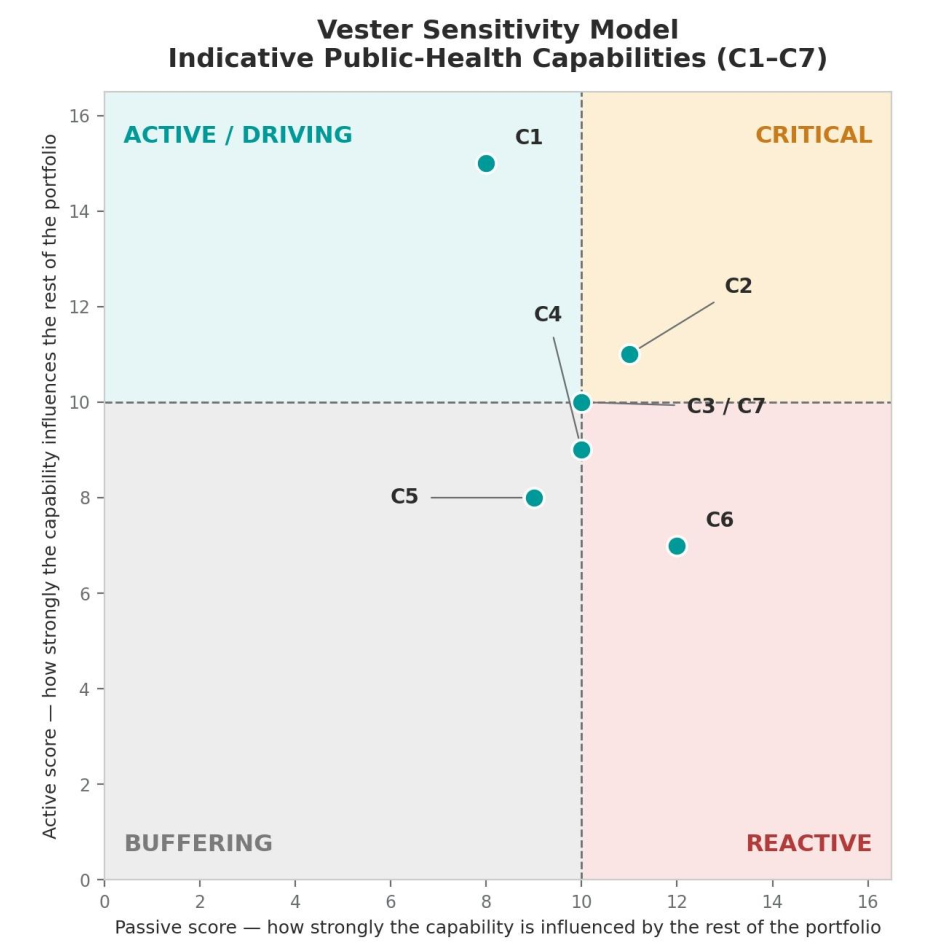
The quadrant a capability falls into is not a scoring artefact; it carries a specific, practical implication for how that capability should be prioritised and managed, and the four quadrants imply four different postures rather than a single ranked list. Active/driving capabilities (top left) score high on active influence and low on passive influence: they move the rest of the portfolio without being much moved by it in return, which makes them comparatively safe, high-leverage places to start — an intervention here is unlikely to be derailed by feedback from elsewhere in the portfolio before it has had a chance to take effect. Critical capabilities (top right) score high on both axes: they drive the portfolio strongly but are themselves strongly driven by it, which makes them high-leverage but also harder to change in isolation, since an intervention here interacts immediately with the rest of the system and can amplify or destabilise as readily as it can improve; they reward deliberate, monitored intervention rather than a single decisive push. Reactive capabilities (bottom right) score low on active influence and high on passive influence: they are moved by the rest of the portfolio far more than they move it, which makes them poor primary intervention points but valuable indicators — a reactive capability that is failing to improve is early evidence that the active or critical capabilities upstream of it are not yet working, even before that shows up anywhere else. Buffering capabilities (bottom left) score low on both axes: they neither drive nor are much driven by the rest of the portfolio, which is a statement about connectivity, not about importance — a buffering capability that performs a protective or stabilising function, as developmental conditions does here, can be essential to the portfolio’s ability to work at all while remaining, correctly, a poor candidate for aggressive early intervention. Read together, the quadrant map gives a defensible order of operations that a ranked list alone does not: start with active/driving capabilities, since they carry the least feedback risk; treat critical capabilities as the highest-value but highest-care targets, worth deliberate joint attention precisely because they are both central and interactive; use reactive capabilities as monitoring and evaluation points rather than levers; and protect, rather than try to drive through, buffering capabilities.
| Rank | Capability | Active | Passive | A×P | A÷P | Systemic role |
|---|---|---|---|---|---|---|
| 1 | C2 — Coordination architecture | 11 | 11 | 121 | 1.00 | Critical — both drives and is driven; its status as the central capability in this diagnosis is corroborated independently. |
| 2 | C1 — System intelligence and learning | 15 | 8 | 120 | 1.88 | Active/driving — the highest active score in the portfolio and the lowest passive score of the top-connected capabilities; this is the foundational, largely self-standing diagnostic function everything else draws on. |
| 3 | C3 — Nested-system design | 10 | 10 | 100 | 1.00 | Borderline/critical — sits exactly at the mean on both axes; its tight coupling to C7 below is the clearest single link in the matrix (a score of 3 in both directions — see §B.4). |
| 3= | C7 — Resource and agency alignment | 10 | 10 | 100 | 1.00 | Borderline/critical by the numbers, despite being the one capability DPH-led public health cannot deliver alone (§4.10) — a genuine tension the numbers do not resolve, addressed directly in §B.4. |
| 5 | C4 — Outcomes, inequalities and displacement | 9 | 10 | 90 | 0.90 | Reactive/borderline — depends heavily on C1’s model and C6’s journey data to have anything to display, and contributes evidence back into C1 and C7 rather than driving the portfolio directly. |
| 6 | C5 — Developmental conditions | 8 | 9 | 72 | 0.89 | Buffering — low connectivity, but low connectivity is not low value: this is the capability that protects every other capability’s relaxation time (§4.11) rather than driving them forward. |
| 7 | C6 — Citizen-facing complexity reduction | 7 | 12 | 84 | 0.58 | Reactive — the highest passive score in the portfolio; this is best understood as an application layer for C1, C2 and C3 rather than an independent lever, though it remains the capability most directly visible to the population the neighbourhood serves. |
B.4 Interpretation and staged sequence
Two capabilities carry the strongest connectivity in the portfolio by different routes: system intelligence (C1) drives the rest of the portfolio while depending comparatively little on it, and coordination architecture (C2) both drives and is driven, sitting exactly in the critical quadrant. This corroborates, by an independent method, the case for treating these as two strengthened, connected capabilities rather than a longer list of separate interventions — the Vester analysis did not have to be steered toward that conclusion; it fell out of the scoring. Nested-system design (C3) and resource and agency alignment (C7) sit together at the boundary of the critical quadrant, and the single strongest link anywhere in the matrix is between them (C3→C7 and C7→C3 both scored 2–3): the subsidiarity map is not really usable without resource authority attached to it, and resource realignment is not really assessable without a prior map of what should be common, local, or in between. This is exactly the tension named in §4.10 — the numbers say this pairing is as systemically central as anything in the portfolio, and yet C7 is the one capability that depends on money and statutory authority a DPH does not hold. That combination — high structural centrality, low direct DPH agency — is arguably the single most important finding this sensitivity analysis adds to the diagnosis: it is a quantified version of the Power Structuration Theorem’s limit (§4.10), and a reason for DPHs to treat convening and evidencing the C3/C7 pairing as a first-order responsibility even where resolving it is not in their gift. Outcomes and displacement tracking (C4) and citizen-facing complexity reduction (C6) both read as largely reactive — C6 in particular has the highest passive score in the portfolio, confirming the diagnosis’s own reading of it as an application layer rather than an independent lever (§4.13) — while developmental conditions (C5) reads as low-connectivity but not low-value: it is the capability that protects the others’ capacity to work at all, rather than one that drives them forward directly.
The analysis suggests a staged rather than a purely ranked sequence: build system intelligence and coordination architecture first, since almost everything else depends on them and they are also the capabilities most fully within DPH-led public health’s own agency; run nested-system design and resource/agency alignment together, in the knowledge that neither is separately actionable and that the second requires partners with authority a DPH does not have; use the resulting model and map to build outcomes/displacement tracking and citizen-facing complexity reduction, since both are shown to be largely downstream rather than independently prioritisable; and protect developmental conditions throughout the sequence rather than treating it as an optional final step, since its low connectivity score reflects its protective function, not its importance.
References
Sources consulted for the factual grounding of the Situation Brief (Technical Analysis, Section 3). Theoretical statements throughout the paper are drawn from the systems-theory reference framework and are not separately footnoted.
1. Department of Health and Social Care, “Neighbourhood Health Framework,” published 17 March 2026, summarised by the NHS Confederation, “Neighbourhood Health Framework: what you need to know.” https://www.nhsconfed.org/publications/neighbourhood-health-framework-what-you-need-know
2. UK Parliament / Hansard, Written Ministerial Statement on the Neighbourhood Health Framework, 17 March 2026. https://hansard.parliament.uk/commons/2026-03-17/debates/26031750000014/NeighbourhoodHealthFramework
3. TheyWorkForYou, Written Statement HCWS1411, 17 March 2026. https://www.theyworkforyou.com/wms/?id=2026-03-17.hcws1411.h
4. Faculty of Public Health / Department of Health, “Directors of Public Health in Local Government: Roles and Responsibilities” (guidance on the statutory basis under the Health and Social Care Act 2012 / NHS Act 2006 s73A). https://www.fph.org.uk/media/1264/dph-roles-and-responsibilities-dh.pdf
5. NHS England / DHSC, “Providing healthcare public health advice to Integrated Care Boards,” published 13 January 2026, updated 24 July 2026. https://www.gov.uk/government/publications/providing-healthcare-public-health-advice-to-integrated-care-boards/providing-healthcare-public-health-advice-to-integrated-care-boards
6. Welsh Government, “Written Statement: Integrated Community Care System Position Statement,” 19 December 2025. https://www.gov.wales/written-statement-integrated-community-care-system-position-statement-0
7. Welsh Government, “Regional Partnership Boards (RPBs).” https://www.gov.wales/regional-partnership-boards-rpbs
8. Welsh Government, “Health and Social Care Regional Integration Fund.” https://www.gov.wales/health-and-social-care-regional-integration-fund
9. Primary Care One / NHS Wales, “Pan Cluster Planning Groups (PCPGs),” Accelerated Cluster Development Toolkit. https://primarycareone.nhs.wales/tools/accelerated-cluster-development-toolkit/acd-toolkit-index/4-pan-cluster-planning-groups-pcpgs/