The Colorado River Basin: A System Without a Regulator
A systemic reading of a water-power-governance system now operating beyond the limits its institutions were designed to hold — a framework-based assessment.
Theoretical basis: the laws and principles of systems theory, applied here as a diagnostic framework rather than as a source of opinion.
Executive Summary
This paper asks a bounded question: what do the laws and principles of systems theory reveal about why a basin serving roughly 40 million people, governed by capable and well-resourced institutions, cannot keep its own critical variables — reservoir storage, hydropower capability, ecological flows, tribal access — within limits? It is not a hydrology report and it does not adjudicate between water users. It applies the framework consistently, naming the governing principle before stating what follows from it.
CENTRAL FINDING
The Colorado River Basin is not primarily short of water; it is short of the capacity to regulate a water-power-ecological-economic system as a whole. Physical and institutional variety has grown faster than the basin's ability to match it: climate non-stationarity, groundwater substitution, renewable integration and rapidly growing large-electricity loads have all added complexity, while the main management responses remain a comparatively small set of reservoir and delivery controls. The system's own dynamics — drawing down storage to delay consumption cuts, financing ecological programmes from a hydropower revenue stream that is itself collapsing — are steering it toward a self-generated crisis rather than merely absorbing an external drought. Reclamation's own July 2026 Final EIS, which abandons a fixed ten-year rulebook for a rolling two-year “adaptive decision framework,” is the clearest evidence yet that the basin's institutions have accepted this diagnosis in practice, even where it has not been named in principle.
Findings in summary: this is a governance-model problem before it is a hydrology problem; the shift to an adaptive framework is a structural concession that there is no stable end-state to plan toward; the basin is being run by a self-reinforcing drawdown dynamic rather than a managed one; institutional fragmentation is now a complexity source in its own right; decisions and their consequences are routinely separated across administrative boundaries; and the same pattern of locally rational, collectively unaccountable behaviour recurs at every level, from an individual water right to the binational treaty with Mexico.
Findings
These findings are the headline output of the diagnosis. The technical analysis that follows names the specific systems principle behind each one and traces how it plays out in the current regulatory situation.
Finding 1. A governance-model problem, not primarily a hydrology problem.
The basin's physical and institutional variety — non-stationary runoff, groundwater substitution, renewable-energy integration, rapidly growing large-load electricity demand, multiplying ecological thresholds — has grown faster than the variety of the institutions managing it. The main levers available (reservoir elevation tiers, annual release volumes, shortage percentages) are a comparatively small, low-variety set. Better hydrological forecasting alone will not close this gap.
Finding 2. The 2036 “adaptive” framework is a concession, not a resolution.
Reclamation's Final EIS, published 31 July 2026, replaces a fixed decadal rule set with operating guidelines reissued roughly every two years through 2036 unless longer consensus arrangements are reached. That design choice is itself an admission that the basin and its environment are structurally coupled and co-evolving, with no stable equilibrium to design toward and then hold — the opposite of how the basin's governing documents, from the 1922 Compact onward, have historically been written.
Finding 3. The system is being drawn down, not merely dried out.
Combined system storage stood at 32% of capacity on 23 August 2026, down from 38% a year earlier. This is consistent with a system whose own operating logic — draw on storage to delay consumption cuts, wait for a wet year — is what is driving it toward a critical threshold, compounded by extraordinary operations that have recurred since 2021 without the system fully re-stabilising between shocks.
Finding 4. Fragmentation is now a complexity source in its own right.
Basin governance spans seven states, more than thirty federally recognised tribes, Mexico, several federal agencies, dozens of irrigation and water districts, regional electricity markets, and a fast-growing set of independent large-load developers. The largest tribal water-rights settlement in U.S. history — covering the Navajo Nation, the Hopi Tribe and the San Juan Southern Paiute Tribe — is currently stalled by the objections of four Upper Basin states, illustrating how each additional independent decision node compounds, rather than simply adds to, the difficulty of reaching a basin-wide accommodation.
Finding 5. Decisions and their consequences are routinely separated.
Economic-development authorities recruit large loads while utilities and water agencies absorb the resulting infrastructure and reliability risk; Reclamation controls reservoir releases while the Western Area Power Administration bears the power-market consequences; a hydropower revenue shortfall now runs into the tens of millions of dollars a year in replacement-power costs alone, without Congress having diversified the funding base for the environmental and adaptive-management programmes that same revenue is meant to support.
Finding 6. The same pattern recurs at every level of the system.
From an individual water-right holder, to an irrigation district weighing conservation against Salton Sea impacts, to a state protecting its own reservoir-elevation priorities, to the binational treaty with Mexico, the basin shows the same structure repeatedly: locally rational actors, each accountable within their own boundary, producing a jointly unaccountable whole.
Technical Analysis
The remainder of this paper sets out the evidence and the systems-theory mechanism behind each finding above: the boundary of the system under examination, the situation on the ground, and the principle-by-principle diagnosis and its cross-cutting dynamics.
1. System Framing and Method
1.1 System Framing
Systems laws describe the behaviour of a defined system in relation to its environment and are only meaningful once that boundary is set explicitly.
| System | The Colorado River Basin water-power-governance system — the coupled hydrological, hydropower, ecological and institutional apparatus that allocates and regulates water and electricity across the basin |
|---|---|
| Key components | Lake Powell, Lake Mead and basin reservoir/conveyance infrastructure; the Bureau of Reclamation and Western Area Power Administration; seven basin states; more than thirty federally recognised tribes; Mexico under the 1944 treaty; irrigation and municipal water districts; electricity markets, utilities and grid operators; agricultural, municipal, industrial and large-load (including data-centre) users; courts |
| Environment | Climate non-stationarity and declining, more variable runoff; rapidly growing municipal, industrial and data-centre electricity and water demand; national and regional electricity-market structure; political pressure over growth, development and conservation; the layered legal framework of the 1922 Compact, the 1944 Mexican treaty, the 2007 Interim Guidelines and the 2026 Final EIS |
| Key dynamic | A widening gap between the basin's physical and institutional variety — non-stationary hydrology, a growing and diversifying set of semi-autonomous decision-makers — and the regulatory variety available to hold the basin's critical variables within limits; now tacitly acknowledged by Reclamation's own shift from a fixed decadal rulebook to a rolling two-year adaptive framework |
1.2 Method
Each section below identifies the governing principle first, states the mechanism by which it operates, and only then derives the implication for the basin, so that findings remain traceable to a named principle rather than appearing as free-standing opinion. Principles are drawn from the full set of systems laws, thinking patterns and miscellaneous systems ideas, and are reported only where they materially apply to this situation — not as an exhaustive checklist. Interaction between principles (“splicing”) is noted at the point each connection is found, rather than deferred to a single later section.
2. Conventional Model and Systemic View Compared
Before turning to the situation itself, it is worth setting the two approaches side by side, since the contrast is the organising question of this paper.
| Conventional assumption | What the systemic view reveals |
|---|---|
| Basin management is fundamentally a hydrology and engineering problem: build enough storage, allocate by legal priority, set operating rules once a decade. | The basin is a socio-technical system in which water, power, ecology and governance are structurally coupled and co-evolving; there is no terminal equilibrium to design toward and then hold (Conservation of Adaptation Principle) — which Reclamation's own shift to a rolling two-year review implicitly concedes. |
| The 1922 Compact's apportionment of 16.5 million acre-feet defines a fixed pie that institutions are dividing. | The Compact's assumptions no longer provide a reliable basis for holding the basin's critical variables within their limits (Homeostasis Principle); the figure is a historical artefact of the accounting architecture, not a description of available supply. |
| Each institution — a state, a district, an agency — can manage its own accountability boundary and the basin will take care of itself. | Connections run both ways even where institutional accounting recognises only one direction (Law of Reciprocity of Connections); what the system actually does, day to day, is protect each actor's own accountability boundary rather than the basin as a whole (POSIWID). |
| Better forecasting and modelling are the main fix the basin needs. | Improved information only helps if it is paired with the authority, contracts and finance to act differently (Law of Requisite Variety); a model without decision rights just observes the crisis more precisely. |
| A below-average year is a one-off shock that reservoir storage exists to absorb. | The basin's buffers — storage, groundwater, institutional trust, funding — are being drawn down faster than they recover; repeated extraordinary operations since 2021 have not let the system re-stabilise (Relaxation Time Principle), and its own operating logic is steering it toward a self-generated critical threshold (Self-organised Criticality). |
| The basin can be treated as a set of separately governable jurisdictions — seven states plus tribes plus Mexico — each solving its own allocation problem. | Institutional fragmentation is a complexity source in its own right, growing combinatorially rather than additively as decision nodes are added (Network Power Law) — visible in the stalled tribal settlement, where four states' objections block a deal affecting the basin's entire accounting architecture. |
3. Situation Brief
Note on sourcing: theoretical statements throughout this paper are drawn from the systems-theory reference framework and are paraphrased rather than quoted at length. Factual claims below are drawn from the sources cited and from the working assessment supplied for this review; unverified or disputed points are flagged explicitly.
Hydrology and storage. Reclamation's most-probable July 2026 24-month study projected a Lake Powell water-year inflow of roughly 3.5 million acre-feet — well below the long-run average. As of 23 August 2026, Lake Powell stood at elevation 3,518.79 feet (22% of capacity, 5,194 thousand acre-feet) and Lake Mead at elevation 1,039.27 feet (27% of capacity, 6,928 thousand acre-feet); combined system storage was 32% of capacity, down from 38% a year earlier.
The Final EIS. Reclamation published its Final Environmental Impact Statement for post-2026 Colorado River operations on 31 July 2026, after more than 18,000 public comments. Rather than a fixed rule set, the Preferred Alternative is described as an adaptive decision framework running through 2036, with operating guidelines reissued at roughly two-year intervals unless the basin states reach longer consensus arrangements — while preserving the Secretary of the Interior's authority to act if consensus does not emerge. Reported operational sideboards include annual Lake Powell releases of 5.0–12.0 million acre-feet, Lower Basin shortages of up to 3.0 million acre-feet, conserved-water storage targets of up to 8.0 million acre-feet at Lake Powell and 3.0 million acre-feet at Lake Mead, and up to 200,000 acre-feet of voluntary Upper Basin conservation. Some secondary reporting cites a larger total reduction figure, up to 3.6 million acre-feet, apparently including assumed reductions to Mexico; this review has not reconciled the two figures against the primary EIS text and flags it as unverified.
Hydropower and the Basin Fund. Declining reservoir levels have cut hydropower output well below design capacity: the Wayne N. Aspinall Unit is projected to generate roughly 30% less than its historical average, and Blue Mesa Reservoir — Colorado's largest reservoir located entirely within the state — is expected to end 2026 at around 17% of live storage, cutting its generating capacity by roughly 18% below design. The Western Area Power Administration has paid substantially more per megawatt-hour for replacement power than it charges customers across 2023–2025 (rates roughly tripled in 2023 before narrowing to around 35% above customer charges by 2025), and spent close to $25 million over 2024–2025 alone on “Cool Mix” replacement power used to protect native fish downstream of Glen Canyon Dam. Congress has not diversified the revenue base supporting the environmental and adaptive-management programmes this same hydropower fund is meant to sustain in the more than thirty years since the 1992 Grand Canyon Protection Act.
Demand growth. Large electricity loads, particularly data centres, are a fast-growing and only recently significant claim on the same water-energy system. Colorado alone has roughly 56 data centres, with one hyperscale facility under construction and major Western utilities forecasting electricity demand growth of around 4.5% a year from 2025 to 2035. Across Arizona, Colorado, Nevada, New Mexico and Utah, on-site data-centre water consumption could rise by roughly 21,600 acre-feet by 2035 — or around 89,700 acre-feet once water used in off-site power generation is included. Colorado regulators are developing large-load tariff, contract and exit-fee frameworks in response.
Tribal water rights. The Northeastern Arizona Indian Water Rights Settlement Act — covering the Navajo Nation, the Hopi Tribe and the San Juan Southern Paiute Tribe, and described as the largest tribal water-rights settlement in U.S. history — would provide roughly $5 billion in federal infrastructure funding and resolve one of the basin's largest outstanding claims; it remains stalled in Congress, opposed by the Upper Basin states of Colorado, New Mexico, Utah and Wyoming over provisions permitting the leasing of water to Phoenix-area cities. Roughly a third of households on the affected reservations lack running water. More broadly, the basin's thirty-plus federally recognised tribes collectively hold rights estimated at a quarter or more of the river's total flow, much of it not yet fully quantified or infrastructure-connected.
The Salton Sea and Imperial Irrigation District. Litigation has been reported (Sierra Club San Diego v. Imperial Irrigation District) challenging a conservation and water-transfer plan on the grounds of its effects on the Salton Sea; this review has not independently verified the claims, current procedural status or specific relief sought, and flags the matter as reported but unconfirmed beyond headline coverage.
What is unverified or unknown: the reconciliation between the 3.0 and 3.6 million acre-foot Lower Basin shortage figures reported across sources; whether the stalled Northeastern Arizona settlement will pass this Congress, and on what terms; the current status and specific claims in the Sierra Club v. Imperial Irrigation District matter; the Western Area Power Administration's full multi-year revenue trajectory beyond the replacement-power figures cited; and, by the nature of the risk being taken, the realised systemic consequences of the Final EIS's adaptive framework, which by design will not be visible until its first two-year review cycles have played out.
4. Systemic Diagnosis
The table below sets out the principles that materially apply to this situation, the mechanism by which each operates, and the effect it implies for the basin. Discussion of each, and the connections between them, follows.
| Principle & Core Statement | Predicted / Observed Systemic Effect | Basin Impact |
|---|---|---|
| Law of Calling + Law of Crossing Difference creates boundaries and boundaries create difference; crossing a boundary is a change of state. | The basin's working boundary — inflows, reservoirs, releases, legal entitlements — is drawn narrower than the differences that now actually drive outcomes: groundwater, hydropower/grid flexibility, large-load electricity demand, Mexico, and the knowledge system itself all sit partly or wholly outside it. | Problems that read as separate crises — power reliability, drought operations, tribal rights, the Salton Sea — are consequences of one under-bounded system; each time the boundary is redrawn (for example, bringing groundwater into shared accounting) it changes the state of what counts as inside and outside. |
| Conant–Ashby Theorem Effective regulation of a system requires an adequate model of that system. | The basin's models are domain-siloed — hydrological, reservoir-operations, power, economic-development, ecological, legal — and none is federated across the couplings that actually drive outcomes. | Interventions are aimed at the wrong resolution: a better inflow forecast does not by itself reveal the replacement-power cost of lost hydropower flexibility, or the Salton Sea consequence of a conservation deal. |
| Darkness Principle There is always something about a system you cannot know. | Climate non-stationarity means even a complete model of today's basin would not fully specify tomorrow's; some unknowns (future hydrology, litigation and settlement outcomes) are structural, not a temporary gap in data. | Reclamation's shift to a rolling two-year framework is the correct systemic response to a genuinely unknowable future, not a sign of institutional weakness — the mistake would be to treat the 2036 horizon as if it were a fixed rule set in waiting. |
| Law of Requisite Variety Management effectiveness depends on matching the variety faced. | Physical and institutional variety — non-stationary runoff, groundwater substitution, renewable integration, large-load growth, ecological thresholds — has grown; the main management responses (elevation tiers, annual release volumes, shortage percentages) remain a comparatively small set. | Sectors where variety is growing fastest — large electricity loads, groundwater — are structurally the hardest for the current control apparatus to hold, regardless of institutional goodwill or funding. |
| System Survival Theorem Systems fail if their environment changes more than the system. | Combined system storage fell from 38% to 32% of capacity in a single year, while a major governance reform (the tribal settlement) has been under negotiation for years without resolution. | This is a rate-matching failure distinct from Requisite Variety's variety-matching failure: direct, current evidence that the basin's own rate of adaptation is not keeping pace with its environment's rate of change. |
| Homeostasis Principle A system is stable so long as its key variables remain within their physiological limits. | The basin has several critical variables — reservoir elevation, consumptive use, hydropower capability, groundwater level, ecological flow, tribal access, affordability — but no single accepted mechanism regulates them together. | The result is threshold competition: protecting one variable (holding water in Powell for power capability) pushes another outside its own acceptable range (downstream delivery, Lower Basin reliability). |
| Relaxation Time Principle A system shocked repeatedly at intervals shorter than its recovery time may never stabilise. | Extraordinary operations have recurred since 2021 without storage returning to a stable baseline between events. | The operative question is no longer simply how much storage remains, but how much adaptive capacity — financial, institutional, political and physical — remains once all the basin's buffers are considered together. |
| Self-organised Criticality A system's own dynamics can drive it toward collapse. | The storage-delay pattern — declining inflow, drawing on storage to postpone consumption cuts, weaker perceived urgency, further decline — describes a system whose normal operating logic, not an external shock alone, is what moves it toward a critical threshold. | This distinguishes the basin's situation from an unlucky drought: deferring cuts and waiting for a wet year is itself the mechanism generating the risk, which compounds directly with Relaxation Time above and the threshold competition under Homeostasis. |
| Conservation of Adaptation Principle Change is the only constant in the relationship between a system and its environment. | The Final EIS explicitly abandons a fixed decadal rulebook for a rolling two-year adaptive framework — a structural concession that there is no stable end-state to plan toward and then hold. | Institutions and observers who still describe the outcome as “the framework that will govern the next decade” risk reproducing the very stabilise-then-hold assumption the framework itself has abandoned. |
| Law of Reciprocity of Connections If A connects to B, B also connects to A, even where institutional accounting recognises only one direction. | Economic-development authorities recruit large loads while utilities and water agencies absorb the resulting risk; Reclamation controls releases while the Western Area Power Administration bears the power-market consequences; irrigation-district conservation can worsen Salton Sea outcomes. | Many of the basin's apparent externalities are not external to the system at all — they are consequences shifted across administrative boundaries, not eliminated. |
| Double Bind (miscellany) Two mutually contradictory imperatives, where satisfying either means failing the other, typically resolvable only from a higher logical level. | Under current single-level operating rules, protecting one critical variable routinely means failing another: dry cooling saves water but can cut summer generating capacity; emergency power replacement protects delivery but weakens Basin Fund revenue. | The classic response is not to pick a side but to reconcile the imperatives at a higher level — jointly tracking basin-wide critical variables rather than optimising each in isolation, which is exactly the function a shared critical-variable framework would need to perform. |
| Power Structuration Theorem A nested system has optimal agency when the system's need for agency is balanced against that of its sub-systems. | The Final EIS preserves the Secretary of the Interior's authority to act unilaterally if consensus does not emerge, even while inviting continued state and tribal negotiation; the stalled tribal settlement shows the same tension in reverse, with four states blocking a deal that would extend agency to three tribes. | Whether this rebalancing improves the basin's overall agency or entrenches gridlock depends on whether the level holding reserved authority has an adequate model of the risk it may need to act on — looping back directly to the Conant–Ashby problem above. |
| Network Power Law Structural complexity grows exponentially, not additively, with the number of interconnected elements. | Basin governance spans seven states, more than thirty tribes, Mexico, several federal agencies, dozens of districts, regional electricity markets and a growing set of independent large-load developers, each an independent decision node with its own accountability boundary. | Adding decision nodes — a new large-load connection agreement, an additional tribal claim — does not add complexity in a straight line; it compounds it, which is a structural reason the tribal settlement and large-load permitting are harder to resolve than their individual stakes suggest. |
| Root Structuration Theorem Complexity is minimised when a system is structured so the number of its sub-systems approaches the square root of its elements. | Rather than consolidating toward fewer, better-coordinated decision points, the basin has been adding independent negotiating parties — large-load developers, additional claimants, state-level regulators — without a corresponding increase in shared coordinating structure. | This is the structural argument for a small number of genuinely cross-domain bodies (a shared observatory, a critical-variable framework) rather than for either a single central controller or an ever-growing list of independent stakeholders. |
| Viability Principle Viability depends on balancing autonomy with cohesion, and stability with change, over time. | The basin currently reads as a set of overlapping viable sub-systems — states, tribes, districts, utilities — each with a strong identity and survival logic, but only a weak shared operational and political identity as a whole. | A single central controller is neither likely nor, on this principle, desirable; the design target is a polycentric but coupled architecture that preserves sub-system autonomy while creating basin-level cohesion around shared critical variables. |
| Structural Viability Theorem A system has optimal viability when its rate of change relative to its environment matches that of its sub-systems. | Sub-systems inside the basin are themselves moving at very different rates — a state legislative session, a multi-year tribal settlement negotiation, a utility's multi-decade infrastructure cycle, and a data-centre's multi-month deployment timeline are all radically out of step with each other and with the pace of hydrological change. | Even a basin that matched its environment's overall rate of change (System Survival Theorem, above) would still generate instability from this internal mismatch — the two theorems describe distinct, compounding failure modes, and both are active here. |
| Adams' 3rd Law A system composed of the lowest-risk components available will itself be a high-risk system. | Each institution — state, utility, district, developer — is individually minimising its own exposure: protecting legal positions, obligation-to-serve, revenue, sovereignty, statutory mandate. Each is individually rational. | The aggregate is high-risk precisely because the basin-wide compromises needed for integration are nobody's job; the safe position for each party is to hold out until others move, which raises rather than lowers the likelihood of abrupt federal action, infrastructure failure, litigation or emergency curtailment. |
| 1st Circular Causality Principle + Feedback Dominance Theorem Positive feedback drives state change; loops with strong feedback take you where they take you, regardless of the size of the input. | The hydropower-revenue loop — lower elevation, reduced generation and flexibility, lower Basin Fund revenue and higher replacement-power cost, weaker environmental and adaptive-management funding, reduced capacity to manage conflict and ecological effects, further constraint — is self-reinforcing and now backed by current figures (roughly 30% below historical generation at one major unit; close to $25 million in replacement-power costs over two years). | Given the strength of this loop, a modest one-off funding top-up is unlikely to change its direction; the intervention has to alter the loop's structure or gain — for example, a funding source decoupled from hydropower output — which is precisely what Congress has not done in the thirty-plus years since the Grand Canyon Protection Act. |
| Fractal Principle Systems tend to replicate their own structural form at different levels. | The same pattern — a locally rational actor optimising within its own accountability boundary while consequences fall elsewhere — recurs from an individual water-right holder, to an irrigation district weighing Salton Sea impacts, to a state protecting its own reservoir priorities, to the binational treaty with Mexico. | Because the mismatch is fractal, an intervention confined to any single level is unlikely to resolve a pattern reproduced at every other level; the problem is structural, not actor-specific. |
| POSIWID (miscellany) The purpose of a system is what it does, not what its designers intend. | What the basin's governance system actually does, day to day, is protect each institution's own accountability boundary — states defend legal positions, utilities protect obligation-to-serve, agencies avoid acting outside mandate — rather than regulate the basin as a whole. | Reforms aimed only at the stated purpose (allocate water more efficiently, generate more power) without addressing the emergent one (protect my own accountability boundary) are likely to be absorbed into that same pattern rather than change it — the systemic form of “every actor is rational within its own accountability, but no actor is accountable for the whole.” |
| Donella Meadows' 12 Places to Intervene (miscellany) Leverage runs from low (parameters, buffers) through structure and feedback to high (information flow, rules, goals, paradigm). | Supply-side and storage interventions sit at the low-leverage “parameters” end of this hierarchy; a shared basin observatory sits at the higher-leverage “information flow” point; a basin-wide critical-variable framework sits higher still, at “rules” and “goals.” | Naming the hierarchy explicitly disciplines sequencing: it is a structural reason to build shared information and rule-setting capacity first, rather than treating every candidate intervention — from desalination to tariff reform — as equally prioritisable on cost or technical merit alone. |
4.1 A boundary drawn too narrow
A traditional river-management boundary contains inflows, reservoirs, releases, diversions and legal entitlements. The Law of Calling holds that a boundary should be drawn around the differences that make a difference to the system, not inherited uncritically from legal or organisational form; the Law of Crossing adds that moving the boundary changes the state of what sits on either side of it. On that standard, the conventional boundary is too narrow. A defensible boundary now includes connected groundwater, hydropower and grid flexibility, large-load electricity demand, the binational relationship with Mexico, and the knowledge system — the forecasts, models, accounting rules and performance measures that determine what the basin's institutions can even see. Problems that read in public reporting as separate — power reliability, drought operations, tribal rights, the Salton Sea — are consequences of one under-bounded system rather than a coincidence of several smaller ones.
4.2 The model-adequacy problem
The Conant–Ashby Theorem states plainly that effective regulation of a system requires an adequate model of that system. Applied here, the basin's models are domain-siloed: hydrological models forecast inflow, reservoir models calculate operations, power models calculate energy and capacity, economic-development models forecast jobs and investment, legal models represent priority and entitlement, ecological models represent habitat and species outcomes — and none is federated across the couplings that actually drive outcomes. The Darkness Principle sharpens the diagnosis rather than excusing it: no system can ever be known completely, and climate non-stationarity means some of what the basin needs to know about its own future is structurally, not just currently, unknowable. Read this way, Reclamation's shift to a rolling two-year adaptive framework through 2036 is not a weakness of the Final EIS; it is the correct response to a genuinely unknowable future. The risk is not in the framework's design but in treating its 2036 horizon as though it were a fixed rule set already decided — which would repeat, on a longer cycle, the same mismatch the framework was built to avoid.
4.3 Variety and survival are different failure modes
The Law of Requisite Variety states that control of a system requires variety at least equal to the variety of the system being controlled. The basin's physical and institutional variety — non-stationary runoff, groundwater substitution, renewable-energy integration, rapidly growing large-load electricity demand, multiplying ecological thresholds — has grown; the main management responses (elevation tiers, annual release volumes, shortage percentages, voluntary conservation payments) remain a comparatively small set. This is distinct from, and compounds, the System Survival Theorem's warning that a system fails if its environment changes faster than the system itself: combined storage fell from 38% to 32% of capacity within a single year, while a major governance reform — the tribal water-rights settlement — has been stalled for years. Variety-matching and rate-matching are different conditions, and the basin is currently failing both at once: it does not have enough kinds of response, and it is not adapting fast enough with the responses it has.
4.4 Homeostasis without a homeostat
The Homeostasis Principle frames a viable system as one whose key variables are held within limits. The basin has the variables — reservoir elevation, consumptive use, hydropower capability, groundwater level, ecological flow, tribal access, affordability — but no single accepted mechanism regulates them together, which produces threshold competition: holding water in Lake Powell protects hydropower capability but reduces downstream delivery; releasing it protects downstream obligations but lowers Powell further; agricultural conservation can protect reservoir storage while damaging local economies or the Salton Sea. This is the Double Bind in its socio-technical form — two mutually contradictory imperatives that cannot be resolved at the level at which they are experienced. The systemic response to a double bind is not to choose a side but to find a higher logical level at which the contradiction dissolves; here, that means treating the basin's critical variables as a single, jointly tracked set rather than as separate mandates handed down to separate institutions.
4.5 A system driving itself to the edge
The Relaxation Time Principle warns that a system repeatedly shocked at intervals shorter than its recovery time may never stabilise. Extraordinary operations have recurred since 2021 without storage returning to a stable baseline between events, and the storage-delay pattern this produces — declining inflow, drawing on storage to postpone consumption cuts, weaker perceived urgency, further decline — is a textbook description of Self-organised Criticality: a condition where a system's own internal dynamics, not an external shock alone, drive it toward a critical threshold. This distinguishes the basin's situation from an unlucky run of dry years. Deferring cuts and waiting for a wet year is the basin's normal operating logic, and it is that logic itself, not any single drought, that is generating the risk. The Conservation of Adaptation Principle explains why the Final EIS's adaptive framework is the structurally correct response: the basin and its environment are continuously co-evolving, so there is no terminal equilibrium to design toward and then hold, and treating the 2026 framework as a one-off settlement — rather than as the first of many required adjustments — would reproduce the very assumption that produced today's buffer exhaustion.
4.6 Externalities that are not external
The Law of Reciprocity of Connections holds that if A connects to B, B also connects to A, even where institutional accounting recognises only one direction. Economic-development authorities recruit large electricity loads while utilities and water agencies absorb the resulting infrastructure and reliability risk; Reclamation controls reservoir releases while the Western Area Power Administration bears the power-market consequences; conservation in the Imperial Irrigation District can worsen outcomes at the Salton Sea. Many of the basin's apparent externalities are therefore not external to the broader system at all — they are consequences shifted across administrative boundaries, not eliminated. Adams' 3rd Law explains why this produces a high-risk whole even though every individual actor is behaving prudently: a system composed entirely of individually low-risk components — each institution protecting its own legal position, obligation-to-serve, revenue base, sovereignty or statutory mandate — is itself a high-risk system, because the basin-wide compromises needed for genuine integration are nobody's specific responsibility. The “safe” position for each party is to hold out until others move, which raises rather than lowers the probability of abrupt federal action, infrastructure failure, litigation or emergency curtailment.
4.7 Fragmentation, agency and the coordination that isn't happening
The Network Power Law states that structural complexity grows exponentially, not additively, with the number of interconnected elements. Basin governance spans seven states, more than thirty federally recognised tribes, Mexico, several federal agencies, dozens of irrigation and water districts, regional electricity markets, and a fast-growing set of independent large-load developers — each an independent decision node with its own accountability boundary. The stalled Northeastern Arizona tribal settlement illustrates the mechanism directly: a deal affecting three tribes and roughly $5 billion in infrastructure funding is blocked by the objections of four states, a veto dynamic that the Root Structuration Theorem suggests is a structural, not merely political, consequence of having too many independently structured decision points relative to the basin's overall complexity. The Power Structuration Theorem adds the agency dimension: the Final EIS explicitly preserves the Secretary of the Interior's authority to act unilaterally if consensus does not emerge, even while inviting continued negotiation — the same recentralisation-versus-autonomy tension visible, in reverse, in the states' block on the tribal settlement. Whether that reserved federal authority improves the basin's overall agency or simply entrenches gridlock depends on whether the level holding it has an adequate model of the risk it may eventually need to act on, looping back to the Conant–Ashby problem in §4.2.
None of this argues for a single central controller. The Viability Principle holds that viability depends on balancing sub-system autonomy against whole-system cohesion, and the basin currently reads as a set of overlapping viable sub-systems — states, tribes, districts, utilities — each with a strong identity and survival logic but only a weak shared operational and political identity as a whole. The Structural Viability Theorem sharpens this further: even setting aside the whole basin's rate of change relative to its environment (§4.3), the sub-systems within it are themselves moving at radically different rates — a state legislative session, a multi-year tribal settlement negotiation, a utility's multi-decade infrastructure cycle, and a data-centre's multi-month deployment timeline are not synchronised with each other or with the pace of hydrological change. The design target these principles together imply is a polycentric but coupled architecture: legitimate local autonomy preserved, with a small number of genuinely cross-domain, basin-wide functions — shared measurement, a jointly held critical-variable framework, independent evaluation — added on top rather than a new central authority substituted underneath.
4.8 The self-reinforcing hydropower loop
The 1st Circular Causality Principle states that positive feedback drives state change, and the Feedback Dominance Theorem adds that loops with strong feedback take a system where they take it, largely irrespective of the size of any single input into them. The basin's clearest such loop runs through hydropower: lower reservoir elevation reduces generation and flexibility, which lowers Basin Fund revenue and raises replacement-power costs, which weakens the environmental and adaptive-management programmes that revenue is meant to fund, which reduces the basin's capacity to manage conflict and ecological effects, which increases operating constraint and fragility — feeding back into further pressure on elevation. Current figures give this loop concrete weight: one major generating unit projected roughly 30% below its historical average output, and close to $25 million spent on replacement power for native-fish protection alone over two years, against a funding structure Congress has not diversified in the more than thirty years since the Grand Canyon Protection Act. Given the strength of this loop, a one-off funding top-up is unlikely to change its direction; the intervention needs to alter the loop's structure or gain — most plausibly, a funding source for environmental and adaptive-management programmes that is decoupled from hydropower output itself.
4.9 One pattern at every scale
The Fractal Principle notes that systems tend to replicate their own structural form across levels. The pattern identified throughout this diagnosis — a locally rational actor, accountable within its own boundary, generating consequences that fall on others — recurs almost identically whether the level examined is an individual water-right holder, an irrigation district weighing conservation against Salton Sea impacts, a state protecting its own reservoir-elevation priorities at the expense of upstream or downstream neighbours, or the binational treaty relationship with Mexico. POSIWID sharpens why this recurs rather than resolves itself: the purpose of a system is what it does, not what its founding statutes say it is for, and what the basin's governance arrangement actually does, day to day, is protect each institution's own accountability boundary rather than regulate the basin as a whole. This is the systemic form of a proposition already close to the surface of the working assessment behind this review — that every actor is rational within its own accountability, but no actor is accountable for the whole — and it means that reforms aimed only at the stated purpose of basin institutions (allocate water more efficiently, generate more reliable power) without addressing the emergent one (protect my own accountability boundary) are likely to be absorbed into that same pattern rather than change it.
4.10 Naming the leverage already implicit in the diagnosis
Donella Meadows' hierarchy of places to intervene in a system runs from low leverage — parameters, buffers, physical stocks and flows — through structure and feedback loops, up to the highest-leverage points: the structure of information flow, the rules of the system, its goals, and the paradigm it operates from. The intervention classes already implicit across this diagnosis sort cleanly along that hierarchy without needing to be forced onto it: supply augmentation and storage reconfiguration sit at the low-leverage “parameters” end; a shared basin observatory — common data definitions, auditable accounting, cross-domain scenario modelling — sits at the higher-leverage “information flow” point; and a basin-wide critical-variable framework, of the kind implied by the Homeostasis discussion in §4.4, sits higher still, at “rules” and “goals.” Naming the hierarchy explicitly does not add a new recommendation so much as it disciplines the sequencing question the diagnosis otherwise leaves implicit: it is a structural reason — independent of, and consistent with, any stakeholder-scored cross-impact analysis of the same intervention set — to build shared information and rule-setting capacity first, rather than treating every candidate intervention as equally prioritisable on cost or technical merit alone.
5. Cross-Cutting Dynamics
Read together, the principles above converge on a single structural account. A widening variety gap (Requisite Variety) compounds a widening rate-of-change gap (System Survival Theorem, Structural Viability Theorem), and both are made worse rather than better by the basin's own operating logic — drawing on storage to defer consumption cuts is precisely the self-organising dynamic (Self-organised Criticality) that a system under repeated, incompletely-recovered shocks (Relaxation Time Principle) would be expected to produce. None of this is a hydrology accident: the basin's governance boundary excludes several of the differences that now drive its behaviour (Law of Calling), its models are siloed rather than federated (Conant–Ashby Theorem), and what its institutions actually do — protect their own accountability boundaries (POSIWID) while connections that run both ways are accounted for in only one direction (Law of Reciprocity of Connections) — compounds structurally with the sheer number of independent decision nodes the basin now contains (Network Power Law), each individually minimising its own risk in a way that raises the risk of the whole (Adams' 3rd Law). The result recurs at every level examined, from an individual right-holder to the binational treaty (Fractal Principle), which is why no single-level intervention — reforming one state's rules, funding one hydropower shortfall, settling one tribal claim in isolation — is likely to resolve a mismatch the framework shows to be systemic rather than local. Reclamation's own answer, a rolling adaptive framework rather than a fixed rulebook (Conservation of Adaptation Principle), is the structurally correct response to that diagnosis; what it does not by itself supply is the shared information architecture and jointly held critical-variable framework — the higher-leverage points on the intervention hierarchy — without which each two-year review cycle risks re-running the same locally rational, collectively unaccountable pattern this paper has traced throughout.
6. Indicative Interventions and Sensitivity Analysis
Additional lens (outside the core framework): this section reports a Vester-style cross-impact and sensitivity analysis carried out in the working assessment supplied for this review. The method is not part of the systems-principles framework used elsewhere in this paper; it is included, clearly separated, because indicative interventions were requested for this review and because its ranking of leverage independently corroborates the diagnosis above.
6.1 Indicative interventions
The working assessment identified ten candidate interventions, deliberately combining physical and institutional elements — its own finding is that the performance of any physical technology depends on the contracts, rights, finance, market access and operating authority that surround it.
I1 — Basin observatory and shared models. This would not operate reservoirs or allocate water; it would provide a common information and assurance layer for a system whose institutions currently manage only fragments of it. Its core functions would be shared data definitions, auditable water and energy accounting, forecast comparison and error analysis, cross-domain scenario modelling, publication of the basin's own critical variables, distributional impact assessment, independent evaluation of pilots, and explicit recording of uncertainty and disagreement. This addresses the model-adequacy problem identified in §4.2 directly: a basin regulated by siloed hydrological, power, economic-development, legal and ecological models cannot see its own couplings, and better forecasting within any one silo does not by itself close that gap.
I2 — Critical-variable framework and adaptive rules. This would give the basin an explicit, jointly agreed answer to the question the Homeostasis discussion in §4.4 leaves open: which variables must be held within limits, and by whom. Candidates include Powell and Mead infrastructure thresholds, firm and flexible power capability, minimum ecological requirements, tribal access and settlement implementation, groundwater decline, salinity, system consumptive use, affordability and vulnerable-customer exposure, and Salton Sea and public-health effects. Converting vague resilience language into observable, jointly tracked homeostatic conditions is the higher logical level the Double Bind discussion in §4.4 argues is needed to reconcile competing thresholds rather than trading them off ad hoc.
I3 — Large-load water–energy requirements. Before incentives, permitting or interconnection of very large electricity loads, this would require a joint water–energy system assessment: proof of water source and drought performance, lifecycle consumptive-use disclosure, cooling-system requirements, flexible or interruptible service where technically possible, a contribution to transmission and water infrastructure, financial security against stranded or emergency costs, and disclosure of assumptions to the basin observatory. It re-couples a decision node — economic-development recruitment of large loads — with the infrastructure and reliability consequences that §4.6 shows are otherwise absorbed elsewhere.
I4 — Stabilised environmental and adaptive-management funding. The Basin Fund's dependence on hydropower revenue is, on this analysis, a priority structural intervention: the self-reinforcing loop traced in §4.8 means that exactly when hydrology makes environmental and conflict-management capacity most necessary, the revenue meant to fund it is collapsing. Potential directions include minimum federal appropriations, multi-year stabilisation reserves, levies spread across the beneficiaries of river operations, reliability or ecosystem-service payments, and a genuinely diversified Basin Fund revenue base — the object is to stop the system's conflict-management capacity from failing at precisely the moment it is most needed.
I5 — Agricultural transition portfolio. Rather than one conservation programme procuring acre-feet, this would combine rotational fallowing, crop switching, deficit irrigation, irrigation modernisation tied to consumptive-use verification, temporary leases, drought options, permanent acquisition only where socially acceptable, community and worker transition funds, Salton Sea mitigation, and groundwater safeguards. Treating agriculture as a portfolio of place-specific mechanisms, rather than one homogeneous user, is itself a Requisite Variety response (§4.3): a single instrument cannot match the variety of agricultural, hydrological and community conditions across the basin.
I6 — Flexible conveyance and demand response. Using pumping, canals, treatment and storage operations as flexible electricity demand treats an existing cross-domain asset — water conveyance — as an institutional prototype rather than merely a technical demonstration. Its value depends on defined operational constraints, compensation for flexibility, settlement across electricity-market seams, clear attribution of savings and risks, protection of water-delivery obligations, and regulatory approval; the technology is, in practice, mostly a contract, tariff and coordination architecture supported by control systems.
I7 — Industrial reuse and low-water cooling. Recycled water, closed-loop systems, dry or hybrid cooling, and long-term municipal–industrial contracts reconnect large water users with the consequences of their consumption without requiring wholesale legal reform. The durable relationship and contract matter as much as the cooling equipment itself: this class can change the rules, information flows and feedback around development decisions faster than most alternatives, but is vulnerable to contracts that shift risk onto less powerful parties or to private confidentiality obstructing basin-wide learning.
I8 — Integrated groundwater–surface-water regulation. Common accounting, monitoring and controls that recognise the hydrological connection between groundwater and surface water close one of the basin's clearest accounting boundaries (§4.1, §4.6): groundwater currently functions as a hidden substitute buffer in parts of the basin, and legal and administrative separation from surface-water accounting can conceal the true scale of system-wide overdraft. Because it is comparatively self-contained, this intervention can exert meaningful influence without every other intervention in the portfolio being complete first.
I9 — Tribal co-governance and infrastructure. Consultation alone does not match the scale of tribal water rights, exposure and opportunity in the basin. This would give tribal nations co-design and decision functions across governance, model design, data ownership, pilot selection, evaluation criteria, benefit-sharing and infrastructure investment decisions — without which any basin-wide information or rule-making architecture will reproduce the same structural exclusion the diagnosis identifies elsewhere (§4.7, §4.9).
I10 — Supply augmentation portfolio. Desalination, advanced reuse, brackish-water treatment and other additional-supply or exchange arrangements can add response variety and reduce pressure on existing rights, particularly where new supply substitutes for consumptive use near the point of demand. Systemic risks include high energy demand, brine or waste disposal, long infrastructure lead times, induced demand, and “new water” that is merely reassigned or double-counted rather than genuinely added; on their own, most supply technologies are supporting interventions rather than a primary correction to the basin's imbalance.
6.2 Cross-impact matrix
Each row was scored 0 to 3 for how strongly implementing that intervention would affect the feasibility or effectiveness of each column intervention — an influence matrix, not an estimate of water saved or cost-effectiveness. The matrix is balanced: total active influence and total passive influence are both 154.
| From ↓ To → | I1 | I2 | I3 | I4 | I5 | I6 | I7 | I8 | I9 | I10 | Active sum |
|---|---|---|---|---|---|---|---|---|---|---|---|
| I1 | — | 3 | 2 | 2 | 3 | 3 | 2 | 3 | 2 | 2 | 22 |
| I2 | 3 | — | 3 | 2 | 3 | 3 | 2 | 3 | 3 | 2 | 24 |
| I3 | 2 | 1 | — | 1 | 1 | 2 | 3 | 1 | 1 | 1 | 13 |
| I4 | 2 | 2 | 1 | — | 1 | 1 | 1 | 1 | 2 | 1 | 12 |
| I5 | 2 | 2 | 1 | 1 | — | 1 | 1 | 2 | 2 | 1 | 13 |
| I6 | 2 | 2 | 2 | 1 | 1 | — | 2 | 1 | 1 | 1 | 13 |
| I7 | 1 | 1 | 3 | 1 | 1 | 2 | — | 1 | 1 | 2 | 13 |
| I8 | 3 | 3 | 2 | 1 | 3 | 1 | 1 | — | 2 | 1 | 17 |
| I9 | 2 | 3 | 1 | 2 | 2 | 1 | 1 | 2 | — | 1 | 15 |
| I10 | 1 | 2 | 2 | 1 | 1 | 1 | 2 | 1 | 1 | — | 12 |
| Passive sum | 18 | 19 | 17 | 12 | 16 | 15 | 15 | 15 | 15 | 12 | 154 |
6.3 Sensitivity quadrant model
Each intervention's row total (its active score — how strongly it influences the rest of the portfolio) is plotted against its column total (its passive score — how strongly it is influenced by the rest). The product of the two scores indicates an intervention's total system connectivity; the quotient indicates whether it is predominantly driving or driven. The mean active and passive score across the portfolio is 15.4, used here as the quadrant division: interventions above both means are critical, those with high active but lower passive scores are active/driving, those with high passive but lower active scores are reactive/driven, and those below both means are buffering.
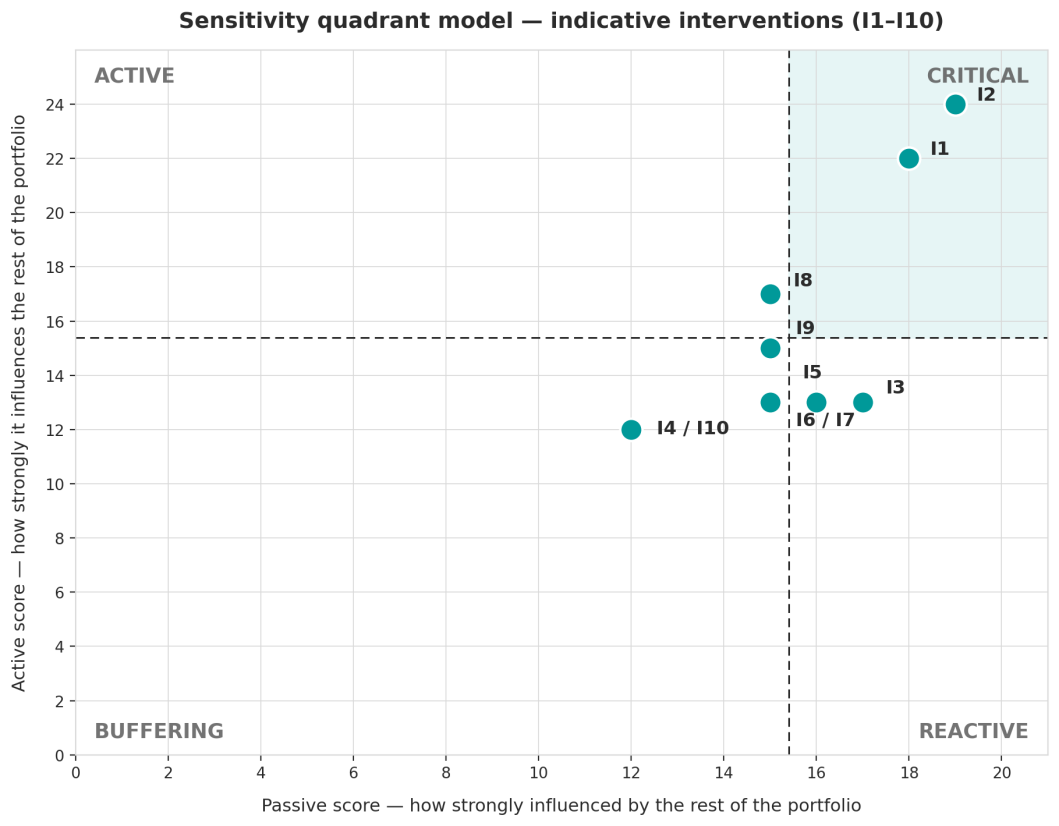
The sensitivity calculations behind the chart, ranked by connectivity (active × passive):
| Intervention & Cross-Impact Scores | Connectivity | Systemic Role |
|---|---|---|
| I2 — Critical-variable framework Active 24, Passive 19, A×P 456, A÷P 1.26. | Highest connectivity in the portfolio. | Critical — defines the thresholds and trade-offs the rest of the portfolio is designed against, but is itself dependent on information, political authority and tribal participation; a relay point, not necessarily the safest place for an abrupt intervention. |
| I1 — Basin observatory/models Active 22, Passive 18, A×P 396, A÷P 1.22. | Second-highest connectivity. | Critical — supports adaptive rules, consumptive-use verification, groundwater accounting and distributional visibility, but its usefulness depends on data access, shared definitions and institutional trust being in place. |
| I8 — Groundwater integration Active 17, Passive 15, A×P 255, A÷P 1.13. | High active, lower passive score. | Active, near-critical — closes a major accounting boundary and can exert meaningful influence without every other intervention being complete first, though not politically easy. |
| I9 — Tribal co-governance Active 15, Passive 15, A÷P 1.00. | Numerically borderline/buffer. | The assessment itself cautions against reading this score literally: participation and legitimacy affect the completeness and legitimacy of the whole architecture in ways a technical cross-impact matrix understates — an instance of the Darkness Principle (§4.2). |
| I3 — Large-load requirements Active 13, Passive 17, A÷P 0.76. | High passive score. | Reactive — better understood as an implementation mechanism for I1 and I2 than as an independent lever; its effectiveness is conditioned by system limits, tariffs and accounting set elsewhere. |
| I5 — Agricultural transition Active 13, Passive 16, A÷P 0.81. | High passive score. | Reactive — a major delivery domain rather than a master lever; its apparent water-saving performance depends on rules for what counts as conserved water, set elsewhere in the portfolio. |
| I6 / I7 — Conveyance / reuse Active 13, Passive 15, A÷P 0.87. | Mid-range, borderline. | Buffer/borderline — plausible bounded pilots that can generate learning while the critical governance and modelling interventions mature. |
| I4 / I10 — Funding / augmentation Active 12, Passive 12, A÷P 1.00. | Lowest connectivity. | Buffer — low connectivity is not low value: I4 is a plausible early no-regrets move that would weaken the hydropower loop in §4.8; I10 adds redundancy without reshaping governance structure. |
6.4 Interpretation and staged sequence
Two interventions sit in the critical quadrant — the basin observatory (I1) and the critical-variable framework (I2) — carrying the highest active and passive scores in the portfolio. This is the sensitivity analysis's own version of the Conant–Ashby and Homeostasis findings above (§4.2, §4.4): I1 supplies the model, I2 supplies the thresholds it is meant to hold, and each is only as good as the other. Integrated groundwater–surface-water regulation (I8) is the clearest active lever outside that critical pair, confirming the boundary problem named in §4.1: closing that accounting boundary can exert influence without every other intervention being complete first. Large-load requirements (I3) and the agricultural transition portfolio (I5) score as reactive — delivery mechanisms operating within whatever thresholds I1 and I2 establish, rather than independent levers. Stabilised environmental funding (I4) scores low on connectivity but is a plausible early move precisely because it would weaken the self-reinforcing hydropower loop identified in §4.8 without requiring the rest of the portfolio to be settled first. Tribal co-governance (I9) scores as borderline on the matrix alone, but the working assessment itself cautions against reading that numerically: participation and legitimacy affect the completeness and legitimacy of the whole architecture in ways a technical cross-impact matrix understates — a direct instance of the Darkness Principle (§4.2).
The analysis suggests a staged rather than a purely ranked sequence: build the observatory, the critical-variable framework, groundwater integration and tribal co-design together first, since these improve the basin's ability to see, interpret and regulate itself; stabilise environmental funding and run bounded conveyance and reuse pilots in parallel, since these generate learning without the whole regime being settled; apply the resulting framework to large-load and agricultural demand once its thresholds and accounting rules are clear, since both are shown to underperform or displace their consequences elsewhere if implemented first; and evaluate supply augmentation last against the same cross-domain framework, since it adds redundancy but does not by itself resolve the basin's structural incoherence. This ordering is independent corroboration, arrived at by a different method, for the same conclusion the framework's own leverage-point hierarchy reaches in §4.10: the basin's highest-leverage interventions are informational and institutional, with physical technologies assembled beneath them as a portfolio, rather than any single technology or programme carrying the basin's difficulty on its own.
Conclusion
Applied consistently, the laws and principles of systems theory suggest that the Colorado River Basin's difficulty is not primarily a question of how much water remains, nor even of how that water should be divided. It is a question of whether the basin's institutions, collectively, hold an adequate model of the system they jointly constitute; whether their combined rate of adaptation matches the rate of change in the environment they face; and whether the basin's genuine need for local autonomy — among states, tribes, districts and utilities — can be reconciled with the cohesion a shared set of critical variables would require. None of these questions are answered by treating the 2026 Final EIS as a settlement rather than as the first cycle of an ongoing adaptive process, and all three recur at every level of the system examined here, from an individual water right to the treaty relationship with Mexico. The practical implication is that intervention confined to any one level or any one domain — however well designed — is unlikely to resolve a mismatch the framework shows to be systemic rather than local; the sensitivity analysis in §6, carried out independently of this framework as part of the working assessment supplied for this review, reaches the same conclusion by a different route: that shared observation and a jointly held critical-variable framework are the interventions most of the basin's other choices structurally depend on, rather than one technology or programme among equals.
Appendix A – Glossary of Systems Principles Referenced
| Principle | Definition |
|---|---|
| Law of Calling | The act of making a distinction is the act of drawing a boundary and defining a system; difference creates boundaries and boundaries create difference. |
| Law of Crossing | Crossing a system boundary is itself a change of state, for both what crosses and the observer. |
| Conant–Ashby Theorem | Every good regulator of a system must be a model of that system; the ability to act effectively on any situation depends on the adequacy of your model of it. |
| Darkness Principle | There is always something about a system you cannot know; irreducible unknowns are structural, not incidental. |
| Law of Requisite Variety | How well any system manages depends on how well it matches the variety it faces; only variety can destroy variety. |
| System Survival Theorem | Systems fail if their environment changes more than the system does. |
| Homeostasis Principle | A system will be stable so long as all its key variables remain within their physiological limits. |
| Relaxation Time Principle | A system repeatedly shocked at intervals shorter than its recovery time may never stabilise. |
| Self-organised Criticality | A condition in which a system's own dynamics drive it toward collapse. |
| Conservation of Adaptation Principle | Change is the only constant in the relationship between a system and its environment; systems and their environments are structurally coupled and co-evolve continuously. |
| Law of Reciprocity of Connections | If A connects to B, then B also connects to A, even where institutional accounting recognises only one direction. |
| Double Bind (miscellany) | A situation constrained by two mutually contradictory imperatives, where satisfying either one means failing the other; typically resolvable only from a higher logical level. |
| Power Structuration Theorem | A nested system has optimal agency when the system's need for agency is balanced against the need for agency of its constituent sub-systems. |
| Network Power Law | Structural complexity grows exponentially with the number of interconnected elements in a system. |
| Root Structuration Theorem | Complexity is minimised when a system is structured so the number of its sub-systems approaches the square root of the number of its elements. |
| Viability Principle | A system's viability depends on balancing the autonomy of its sub-systems against the cohesion of the whole, and stability against adaptation, over time. |
| Structural Viability Theorem | A system has optimal viability when its rate of change relative to its environment is similar to that of its sub-systems. |
| Adams' 3rd Law | A system composed of the lowest-risk components available will itself be a high-risk system. |
| 1st Circular Causality Principle | Positive feedback drives state change. |
| Feedback Dominance Theorem | Loops with strong feedback will take a system where they take it, largely irrespective of the size of the input. |
| Fractal Principle | Systems tend to replicate their own structural form across different levels of scale. |
| POSIWID (miscellany) | “The Purpose Of a System Is What It Does” — a system's real, emergent purpose is revealed by its actual behaviour rather than by the intentions ascribed to it. |
| Donella Meadows' 12 Places to Intervene (miscellany) | A hierarchy of leverage points for intervening in a system, running from low leverage (parameters, buffers) through structure and feedback loops to high leverage (information flow, rules, goals, paradigm). |
References
Sources consulted for the factual grounding of the Situation Brief (Technical Analysis §3), supplementing the working assessment supplied for this review. Theoretical statements throughout the paper are drawn from the systems-theory reference framework and are not separately footnoted.
1. U.S. Department of the Interior, “Reclamation Publishes Final Environmental Impact Statement for Future Colorado River Operations,” 31 July 2026. https://www.doi.gov/pressreleases/reclamation-publishes-final-environmental-impact-statement-future-colorado-river
2. Bureau of Reclamation, “Post-2026 Colorado River Operations — Final Environmental Impact Statement.” https://www.usbr.gov/ColoradoRiverBasin/post2026/final-eis/index.html
3. Bureau of Reclamation, “Lower Colorado Weekly Hydrologic Update,” 23 August 2026. https://www.usbr.gov/lc/region/g4000/weekly.pdf
4. Bureau of Reclamation, “July 2026 Most Probable 24-Month Study.” https://www.usbr.gov/uc/water/crsp/studies/24Month_07.pdf
5. Utah News Dispatch, “As Colorado River and tributaries shrink, a public power system frays,” 16 July 2026. https://utahnewsdispatch.com/2026/07/16/as-colorado-river-and-tributaries-shrink-a-public-power-system-frays/
6. Colorado Sun, “Data centers are coming to Colorado. Can the parched state handle their big water needs?,” 26 January 2026. https://coloradosun.com/2026/01/26/colorado-data-center-explainer-water-use-ai/
7. Western Water, “Data center boom raises water, power questions,” 26 March 2026. https://www.western-water.com/2026/03/26/data-center-boom-raises-water-power-questions/
8. Circle of Blue, “Native American Tribes Came Together to Secure Their Rights to Colorado River Water. Four States Are Stalling the Deal.” https://www.circleofblue.org/2026/water-policy-politics/water-rights-access/native-american-tribes-came-together-to-secure-their-rights-to-colorado-river-water-4-states-are-stalling-the-deal/
9. ProPublica (syndicated via Colorado Newsline), “Native American tribes came together to secure their rights to Colorado River water. Four states are stalling the deal,” 3 July 2026. https://coloradonewsline.com/2026/07/03/states-stalling-water-rights-deal/
10. Fox 5 San Diego, “Sierra Club of San Diego sues Imperial Irrigation District over Colorado River conservation plans' impact on Salton Sea.” (Headline reporting only; underlying filing not independently verified for this review.) https://fox5sandiego.com/news/local-news/imperial-irrigation-district-sued-over-colorado-river-conservation-plan/
11. Working assessment: “Colorado River Basin water–power system — a systems-thinking diagnosis,” supplied by Patrick, including an indicative portfolio of candidate interventions and a Vester cross-impact and sensitivity analysis of them (reported in §6).